
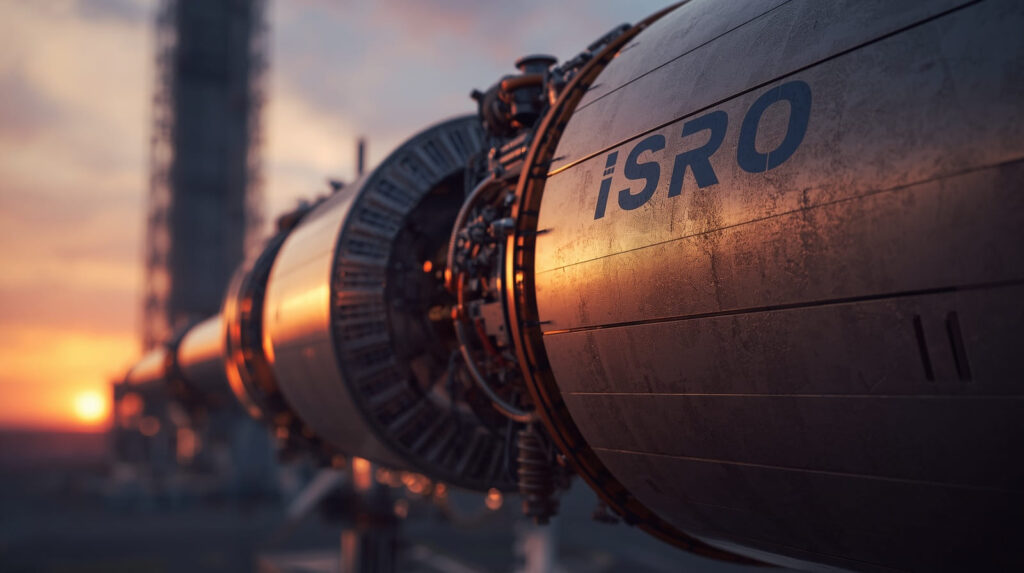

Bengaluru: The 2,000-kilonewton semicryogenic engine was developed by the Indian Space Research Organisation (ISRO) for use in future missions, while a ground test also was conducted of a new solid motor for the Indian Sub-Orbital Launch Vehicle for Experiments or SOLVE.
The tests seek to enhance India’s heavy-lift capability, augment payload performance and offer platforms for scientific experiments and technology demonstrations.
Semicryogenic engine reaches higher thrust
ISRO successfully conducted a hot test of the Semicryogenic Engine Power Head Test Article (PHTA) at the ISRO Propulsion Complex in Mahendragiri, Tamil Nadu, on June 24, 2026.
At test, the power head controlled at 175 tonnes of thrust, or approximatley 88% of its targeted 200-tonne thrust level. The PHTA was also 1st tail in the new higher thrust level hot tests and it was their 8th hot test in this series.
The test ran as planned with the measured engine parameters remaining within their predicted ranges. The power head also completed tests of its main turbopumps, which operated successfully at outlet pressures of 400 and 500 bar.
What is the power head?
The power head is the part of an engine containing key systems like the turbopumps, pre-burner, start system and other related control components. It does not include the thrust chamber, where the fuel and oxidizer are burned to produce the final thrust.
For instance, testing the power head on its own gives engineers a chance to validate systems such as fuel-feed and turbopump ahead of tests involving the fully assembled engine.
The newest test emphasized the sequence at Start with ignition of the engine in pre-burner as well and stable operating first stage of engine design, which is over a thousand times more thrust.
LOX-kerosene propulsion
ISRO’s semicryogenic engine is being developed to use a combination of liquid oxygen and kerosene. Liquid oxygen acts as the oxidiser, while kerosene serves as the fuel.
Compared with some conventional cryogenic systems, a semicryogenic engine using kerosene can offer several operational advantages:
- Higher propellant density.
- More compact tank requirements.
- Easier fuel handling than liquid hydrogen.
- High thrust for booster applications.
- Potentially improved launch-vehicle performance.
- Greater suitability for heavy-lift missions.
ISRO has stated that the 2,000-kilonewton engine is intended to enhance the payload capability of the LVM3 and support future launch vehicles.
Importance for LVM3
The new engine is expected to be used for a future semicryogenic booster stage for the LVM3, India’s heavy-lift launch vehicle. That could boost the payload capacity of the rocket to geostationary transfer orbit from about four tonnes to more like five tonnes.
Greater payload capacity would enhance India’s capability to deploy heavier communication satellites, bigger spacecraft and more complex scientific missions.
The engine might likewise serve as the basis for future crewed launch-vehicle alternatives, along with deep-space and big orbital infrastructure.
Next phase of testing
The successful 175-tonne test has given ISRO confidence to proceed towards a full-power demonstration at the planned 200-tonne thrust level.
Further tests will be required before the engine can be integrated into an operational launch vehicle. These are expected to include:
- Full-power power-head tests.
- Long-duration hot tests.
- Testing of the thrust chamber.
- Complete-engine hot firing.
- Stage-level testing.
- Structural and vibration qualification.
- Flight-readiness evaluations.
Engine qualification is a lengthy process because every major subsystem must demonstrate reliable performance under the extreme pressure, temperature and vibration conditions of a launch.
New SOLVE solid motor tested
In addition to the Semicryogenic engine programme, ISRO conducted the ground test of a 4.5meter Solid Motor for its new Sub-Orbital Launch Vehicle for Experiments (SOLVE) at Static Test Facility of Satish Dhawan Space Centre, Sriharikota.
The motor was tested on July 3, 2026, and the performance parameters were said to be in line with expectations.
SOLVE was designed to offer a sub-orbital platform for experiments and technology demonstrations. These types of vehicles would be useful to researchers trying to test instruments, materials and systems in near-space settings prior to their application on orbital missions.
Role of solid motors
Solid rocket motors are widely used in launch vehicles because they offer high thrust, relatively simple construction and long-term storage capability. Once ignited, however, a solid motor generally cannot be throttled or shut down in the same way as many liquid engines.
A successful ground test helps engineers assess:
- Thrust generation.
- Chamber pressure.
- Propellant burn behaviour.
- Structural loads.
- Temperature profiles.
- Vibration.
- Nozzle performance.
- Control and instrumentation systems.
Data from the SOLVE test will be used to refine the motor and vehicle design before future flight demonstrations.
Supporting scientific experiments
Sub-orbital vehicles such as SOLVE can provide researchers with a lower-cost and faster way to conduct experiments in microgravity or near-space environments. The vehicle may support experiments involving:
- Materials processing.
- Fluid behaviour.
- Combustion.
- Biology.
- Atmospheric science.
- Space sensors.
- Avionics.
- Re-entry technologies.
- Communication systems.
These experiments can be completed without the cost and complexity of placing a satellite into orbit.
Broader launch-vehicle ambitions
While both the semicryogenic and solid-motor programmes are complementary, they stand as two pillars of India’s overall launch-vehicle industry.
The semi cryogenic engine will help in improving the fuel efficiency and power of heavy-lift rockets. The SOLVE solid motor is designed for experimental and sub-orbital missions.
Collectively, these developments will help ISRO develop a more diverse set of launch systems for missions ranging from small scientific payloads to larger communications satellites and human-spaceflight infrastructure.
Link with human spaceflight
A relevant project for India’s human-spaceflight future is its semicryogenic engine programme. An advanced propulsion system that has higher thrust and efficiency levels may find an application for future heavy-lift vehicles needed to support human missions, space-station assembly, and lunar exploration.
So, ISRO is developing the Gaganyaan programme where high reliability for launch vehicles, crew systems, abort mechanisms and recovery operations are needed. All new propulsion technology planned for any kind of human rated missions will require years of validation and safety testing.
Strengthening domestic capability
The development of advanced engines and solid motors inside India supports the country’s objective of building greater self-reliance in space technology. It also creates opportunities for domestic industry and research institutions to participate in manufacturing, testing and qualification.
Indian companies may contribute to:
- Precision-engineered engine components.
- Propellant systems.
- Sensors and instrumentation.
- Control electronics.
- Composite structures.
- Ground-support equipment.
- Testing and data-analysis systems.
A reliable domestic supply chain will be essential as ISRO increases the frequency and complexity of future launches.
What happens next?
The more urgent part of the semicryogenic programme is higher thrust and longer duration tests, and full engine integration followed by booster stage testing. Engineers will analyze test data on the ground and bring the vehicle toward future development and flights for SOLVE.
The operational deployment of either CTV or TVM is predicated on the completion of numerous qualification milestones associated with both programmes. One successful flight shows progress, but launch vehicles need to act reliably through a full sequence of tests and missions.
A major propulsion milestone
However, two important propulsion programmes that are critical to the ISRO prerogative have just pulled off yet another test each with hardly a ripple. In addition, the semicryogenic power head achieved a thrust of175 tonnes in a successful hot test while the SOLVE solid motor had what were characterised as expected performance parameters during its first ground test.
The developments could enhance India’s heavy-lift launch capability, enable scientific exploration and offer propulsion technologies for future human-spaceflight and deep-space endeavors. Additional work will establish how fast these systems can transition from a developer side of the house to operational launch vehicles.