
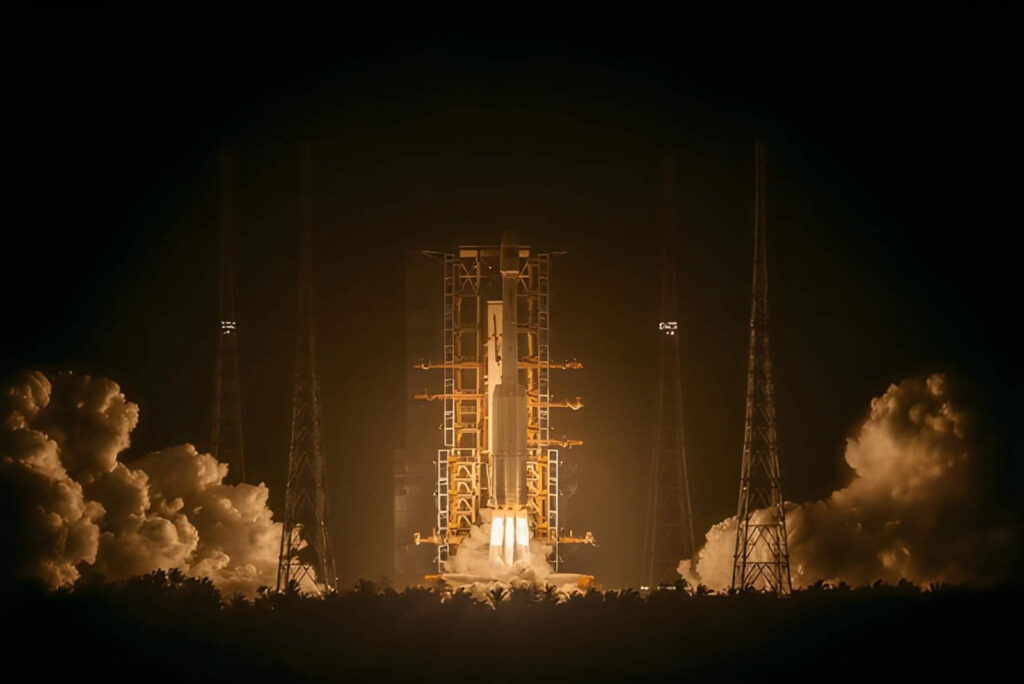

This particular flight occurred at 8:02 p.m. Beijing time (1202 GMT) on Monday, August 10, 2026 when a Chinese Long March 7A (CZ‑7A) rocket launched from Wenchang Space Launch Site on Hainan Island to place Zhongxing‑4B / ChinaSat‑4B communications satellite into geostationary orbit.
About 85 seconds into the flight, during stage one ascent and far below the altitude where stage separation typically occurs, it experienced a major failure exploded in a giant fireball as multiple videos posted myself.
Three hours later, state news agency Xinhua confirmed the failure but gave just China Manned Space Agency only said that the rocket had undergone an “anomaly during flight” and it was unclear what caused the problem, without going into technical details.
No technical details have yet been made available from the state-owned China Aerospace Science and Technology Corporation (CASC), which manages the Long March family, and an official launch report by China National Radio subsequently went offline.
Payload loss and mission impact
According to Chinese state media the rocket was also carrying the ChinaSat-4B (also known as Zhongxing-4B) satellite, which was to offer radio, television and other communications services to users worldwide.
Space analysts who examined video from the launch believe the vehicle broke up at a relatively low altitude and speed, so neither the satellite nor substantial debris made it to orbit.
That renders the mission a complete loss of both vehicle and satellite, and into question how soon a replacement can be assembled and put in orbit given where its orbital position would need to be along with also providing service, rather than just inflating that.
A Long March 7A rocket that lifted off from Wenchang around 12:00 UTC today carrying an unknown payload exploded around 85 seconds into the flight. https://t.co/26acDHSdrS pic.twitter.com/Z48DjCm0C5
— Andrew Jones (@AJ_FI) August 10, 2026
Flight profile and where it went wrong
The Long March 7A is a three‑stage, liquid‑fuel rocket derived from the Long March 7, optimised for high‑energy missions to geostationary transfer orbit (GTO) and other high orbits.
Key points in a nominal CZ‑7A ascent:
- First‑stage burn: Core stage plus four side boosters fire together from liftoff.
- First‑stage separation: Typically occurs just under three minutes after liftoff, when the clustered boosters and core stage separate as a unit.
- Second and third stages: Take over to push the payload toward GTO.
In this case, the failure at ~85 seconds means the anomaly occurred during the main first‑stage engine burn, before the rocket reached the point where boosters and core stage would normally separate.
Experts analysing video noted that the explosion happened while the vehicle was still low enough and slow enough that the breakup was clearly visible from the ground near the coastal spaceport, with onlookers audible gasps captured in some clips.
Investigation focus: Isolated glitch or systemic issue?
Chinese authorities have not disclosed the specific cause, but the investigation is expected to focus on several possibilities:
- Engine malfunction in the core stage or one of the side boosters, similar to the issue identified after the CZ‑7A’s maiden‑flight failure in March 2020.
- Structural or aerodynamic failure under high dynamic pressure during early ascent.
- Propulsion feed or control‑system anomalies, such as turbopump failure, valve malfunction or guidance errors leading to excessive loads.
- Manufacturing or quality‑control defects in components shared across the Long March 7/7A family.
Jonathan McDowell, a space analyst and honorary professor at Durham University, noted that because the rocket was destroyed at low altitude and speed, the failure likely originated early in the first‑stage burn, before any complex staging events.
Blaine Curcio of Orbital Gateway Consulting described the accident as “not a great development” for the Long March 7A programme but added that, based on available information, the damage seems limited and does not necessarily indicate a fleet‑wide crisis.
The critical question for China’s space establishment is whether the problem is:
- Specific to this vehicle or batch (e.g., a particular engine or component), or
- Indicative of a broader issue affecting shared components, manufacturing processes or launch‑site operations, which could require wider inspections and temporary grounding of related rockets.
Track record of the Long March 7A
The Long March 7A entered service in 2020 as China’s primary medium‑to‑heavy launcher for high‑orbit missions, complementing the larger Long March 5 and the smaller Long March 2/3/4 families.
Before this incident:
- The rocket had flown 17 missions since its debut.
- It had recorded only one prior failure, on its maiden flight in March 2020, which was traced to an engine malfunction shortly after first‑stage separation.
- That gave the CZ‑7A a high success rate (16 successes out of 17 flights) heading into this launch.
With the August 2026 failure, the rocket’s record becomes 16 successes and 2 failures in 18 flights, still relatively strong by global standards but now under closer scrutiny as China scales up its launch cadence.
Implications for China’s launch programme
China has been running one of the world’s busiest launch schedules, with dozens of missions per year supporting:
- Communications and navigation satellites (including the BeiDou constellation and new broadband networks)
- Remote‑sensing and Earth‑observation platforms
- Crewed spaceflight, space station resupply and lunar exploration (including the upcoming Chang’e‑7 lunar mission)
Analysts expect this failure to:
- Prompt a pause or slowdown in upcoming Long March 7A launches while telemetry is analysed and any necessary design or process changes are implemented.
- Lead to reviews of similar components across related Long March variants that share engines, avionics or structures.
- Reinforce the message that even mature rockets can suffer catastrophic failures within seconds of liftoff, underscoring the inherent risk of orbital launch operations.
Importantly, the failure is not expected to directly endanger China’s Chang’e‑7 lunar mission, which is set for later in 2026 and will likely employ the larger Long March 5 rocket instead of the 7A.
But a long grounding or major 7A redesign could impact schedules of geostationary communications satellites and other high‑orbit payloads that depend on this launcher.
Collateral effects: Delays and market perception
Following the Long March 7A failure, at least one high‑profile launch was reportedly delayed:
- The much‑anticipated debut flight of the Zhuque‑3 rocket from Jiuquan, planned for Tuesday morning after the CZ‑7A incident, was postponed, according to Chinese financial media citing sourced information.
While it is unclear whether the Zhuque‑3 delay was directly caused by the Long March 7A explosion or by separate technical or scheduling issues, the timing has fueled speculation about heightened caution across China’s launch sector after such a visible failure.
Internationally, the incident is likely to:
- Be cited by competitors and analysts as evidence that China’s rapid launch tempo carries non‑trivial reliability risks.
- Prompt satellite operators to re‑evaluate insurance premiums and contingency plans for missions booked on Chinese rockets, especially for high‑value communications payloads.
At the same time, observers including Elon Musk noted on social media that “Rockets are insanely hard,” highlighting that even the most experienced operators face occasional catastrophic losses.
What to watch next
Over the coming weeks and months, key indicators will include:
- Official investigation findings from CASC and Chinese space authorities on the root cause (engine, structure, control system, etc.).
- Any temporary suspension of Long March 7A launches or fleet‑wide inspections of related vehicles.
- Changes to the manifest of upcoming missions, especially geostationary communications satellites that were slated for CZ‑7A.
- Whether similar anomalies appear in other Long March variants that share critical components, which would signal a broader quality or design issue.
For now, the August 10 explosion stands as a stark reminder that, despite decades of experience and an ever‑busier launch calendar, orbital rocketry remains a high‑risk endeavour where a single component failure can turn a routine mission into a fireball less than two minutes after liftoff.