
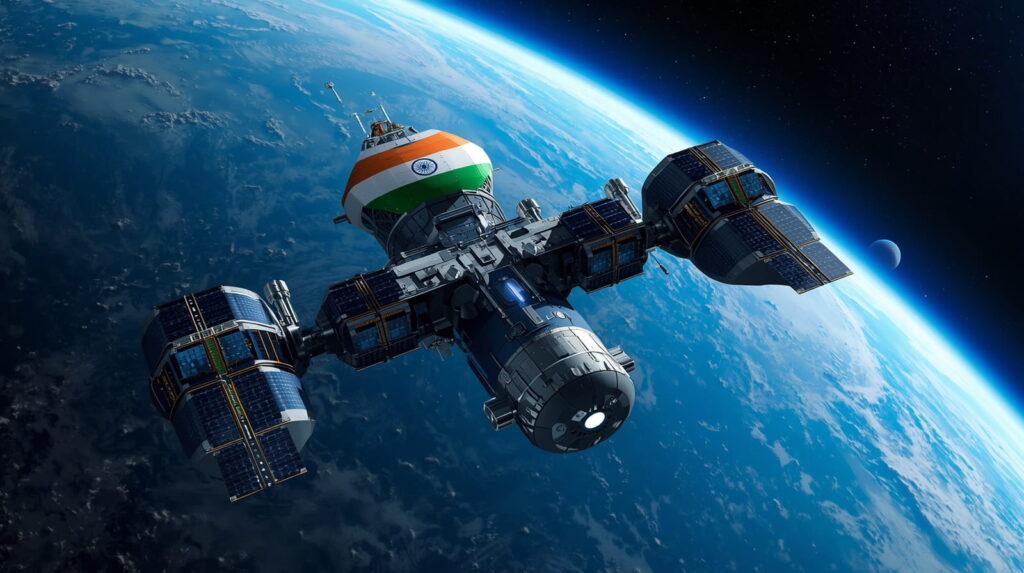

Bengaluru: Indian Space Research Organisation (ISRO) launched performance envelope, development stations and went into detail subsystem-design activities of Bharatiya Antariksh Station (BAS), India’s planned modular space station at lower Earth orbit. The initial phase, called BAS-01 is slated for launch 2028 with a final five module station expected to be operational by 2035.
The project is an enormous leap for India’s human-spaceflight programme, shifting capabilities from flying solo crewed missions to long-duration orbital research and infrastructure.
Design work moves forward
This means ISRO had already completed the baseline design review and system-engineering work on BAS-01. As per the available project updates, 31 baseline design documents have been prepared and reviewed by an expert committee, enabling engineers to commence with detailed designing of the module’s individual subsystems.
These activities will potentially encompass investigation into the structural, power, thermal, communications, docking, environmental-control and life-support systems required for an orbital facility capable of supporting a crew.
That’s why this design phase is so crucial, a space station operates non stop in a very challenging environment. More than for a short-term satellite mission, it needs long-term durability, the potential for repair and crew safety.
First module planned for 2028
The first of the station elements, BAS-01 is intended to serve as a base for the future orbital iteration. The initial development and launch of the first module was approved by Union Cabinet in October 2023 with a target date for launch being set as 2028
The launch of the module will use India’s LVM3 heavy-lift rocket. It will be in the range of 9–10 tonnes weighed, and it will be stationed about 400–450 km above the surface of Earth on a low Earth orbit.
BAS-01 is expected to include essential technologies such as:
- Docking systems.
- Hatches and berthing mechanisms.
- Environmental-control and life-support systems.
- Power-generation equipment.
- Crew-support systems.
- Technologies for microgravity operations.
- Infrastructure for future station expansion.
Five-module space station
The full Bharatiya Antariksh Station is planned as a five-module facility assembled in stages. The modular design will allow ISRO to launch and integrate the station gradually rather than placing the entire structure into orbit in one mission.
The planned modules are expected to include:
- A base module.
- A core or docking module.
- A science-research module.
- A laboratory module.
- A common working or berthing module.
The final station is expected to support a nominal crew of three to four astronauts, with the capacity to accommodate up to six astronauts for shorter periods.
Research in microgravity
The BAS will serve as an orbital laboratory for scientific experiments and technology demonstrations. Microgravity research can provide insights that are difficult or impossible to obtain on Earth.
Potential areas of research include:
- Materials science.
- Fluid dynamics.
- Combustion.
- Biotechnology.
- Human physiology.
- Space medicine.
- Plant growth.
- In-space manufacturing.
- Life-support technologies.
- Robotics and autonomous operations.
Research conducted aboard the station could support future lunar missions and other deep-space objectives by helping scientists understand how humans, materials and biological systems behave during extended spaceflight.
Link with Gaganyaan
The Gaganyaan human-spaceflight programme is intrinsically akin to the Bharatiya Antariksh Station. Gaganyaan is planned to test enablers for Indian human spaceflight, e.g., crewed-rated launch systems and subsystems (crew escape, life support, re-entry and recovery).
The government has outlined a multi-stage roadmap to achieve this, with more flights of Gaganyaan and technology-demonstration missions leading up to the first BAS module being launched before 2030.
Data from Gaganyaan will delp ISRO draw interms of what procedures will be needed to carry astronauts to the station(s), how docking ops take place and how crew are kept safe while they’re in orbit.
Indigenous technologies
This would entail India developing and domestically qualifying several technologies for the first time as part of the station programme. This encompasses docking systems, crew hatches, environmental-control gear and long-term life-support hardware.
The first module will include homegrown systems for microgravity and future spacewalks.
Developing these capabilities in India is likely to bolster the country’s aerospace manufacturing base, and shrink reliance on foreign technologies for human-spaceflight infrastructure.
Opportunities for Indian industry
The programme is also expected to create opportunities for Indian aerospace companies, research institutions and advanced manufacturers. Private-sector participation may include production of structural components, electronics, life-support equipment, thermal systems, robotics and ground-support hardware.
A multi-module station will require repeated production, testing and delivery of large, high-reliability components. This could help develop specialised industrial capacity in areas such as:
- Human-rated space hardware.
- High-strength aluminium structures.
- Precision docking components.
- Space-qualified electronics.
- Environmental-control systems.
- Robotic assembly and servicing.
- Advanced materials and insulation.
The project may therefore contribute not only to scientific capability but also to the growth of India’s commercial space ecosystem.
Strategic importance for India
The establishment of a national space station would provide India with an independent platform to conduct composite crewed research in orbit. It might ease dependence on outside sites but also provide a long-term test bed for technologies required to reach the Moon — and eventually, even farther.
It would also place India in a small club of nations working towards sustained human presence low-Earth orbits. A permanent station in orbit can support training of astronauts, scientific collaboration, variable testing and advancement capabilities for national-space policy goals.
Challenges ahead
The programme faces substantial engineering and operational challenges. A crewed space station must maintain safe air pressure, temperature, radiation protection, power, communications and waste-management systems for long periods.
Major technical challenges include:
- Developing reliable closed-loop life support.
- Ensuring autonomous rendezvous and docking.
- Protecting astronauts from radiation.
- Maintaining safe thermal control.
- Managing fire and emergency situations.
- Supporting crew health during extended missions.
- Resupplying and servicing the station.
- Establishing reliable ground-control systems.
- Integrating multiple modules in orbit.
Testing and validating these systems will require a sequence of uncrewed and crewed missions.
Completion targeted for 2035
The initial BAS module, comprising two modules connected by a seam nose-to-nose and linked to an artificial gravity space structure with pressurized crew vessels, will be completed in time for a 2028 launch. The entire five-module BAS station is expected to be operational by 2035. pib. gov+1
This staged approach would enable ISRO to grow the facility incrementally as launch vehicles, crewed missions and station technologies mature. The first modules may be for basic systems, with later modules increasing laboratory, crew and logistics capacity.
This configuration will be finalized in low Earth orbit at a distance of about 400–450 km from the surface of Earth.
A new phase in India’s space programme
Transitioning from concept development to implementation, the detailed subsystem design indicates a major milestone. ISRO is now a step closer to putting the design into manufacturing, testing and launch phases with the BAS-01 design review having been completed.
The Bharatiya Antariksh Station hopes to seem larger than its national veneer. This could give India a platform for microgravity research, astronaut training, industrial experimentation and preparation for future lunar exploration.
Should that launch target be met by 2028, and the remainder of the modules assembled as planned, India should complete a significant step toward establishing its own independent human marine presence in orbit by 2035.