
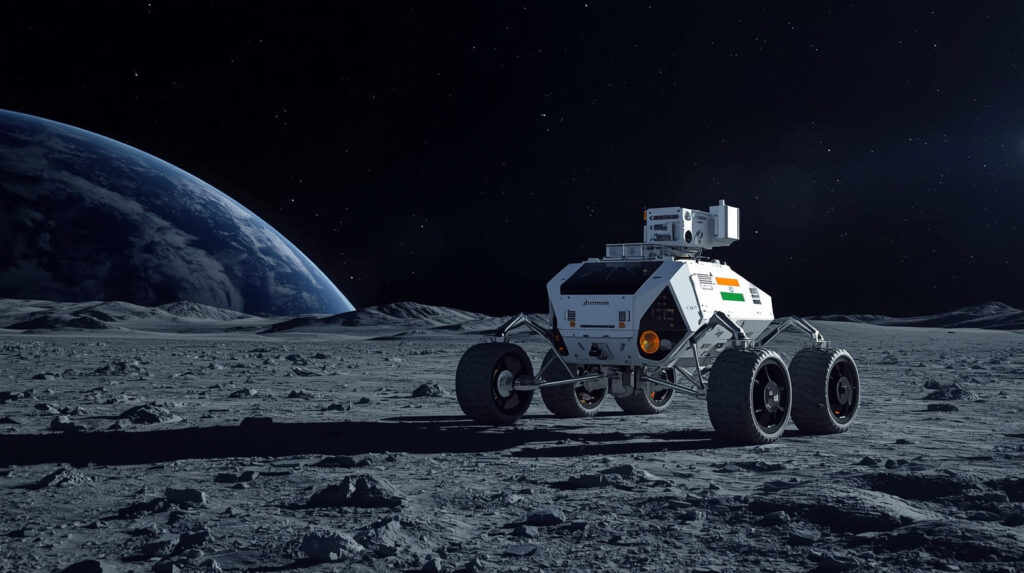

Two important discoveries about the Moon: Chandrayaan-2 radar data suggest possible subsurface water ice near the lunar south pole, and measurements of its landing site track linked soil to a lunar meteorite on Earth. Taken together, the findings give fresh insight into lunar resources andits geological history — with implications for the scientific potential offuture south-polar missions. isro.
Chandrayaan-2 detects possible buried ice
The study made use of lunar data from the Dual Frequency Synthetic Aperture Radar (DFSAR) of Chandrayaan-2, and was led by scientists from the Physical Research Laboratory in Ahmedabad focusing on permanently shadowed regions near to south pole. They do not get much or any direct sunlight, and they can be very cold, leading to possible water-ice in the subsurface remaining stable and lasting a long time. i
The researchers investigated doubly shadowed craters, which sit inside of larger regions that are perpetually shunned by sunlight. In the case of four such craters, radar observations detected indications similar to subsurface ice just below the floors.
Strong signal in Faustini crater
One of the most persuasive pieces of evidence was a 1.1-kilometre-wide hole within the Faustini crater. Radar characteristics and surface features suggesting buried ice were discovered by the scientists. isro.
The lobate-rim morphology is odd for an impact, which typically has a flow-like or rounded rim structure; however the unusual features of the crater may mean that it interacted with ice and/or volatile-rich material beneath the surface. Nevertheless, it is radar-based evidence and not physical confirmation from a drilled or delivered sample.
How the radar identified ice
To study the lunar surface and shallow subsurface, DFSAR employs L-band and S-band radar signals. The researchers analysed two radar characteristics: the circular polarisation ratio and degree of polarisation.
The study suggested that volumetric scattering related to subsurface ice was indicated by a circular polarisation ratio greater than 1 and degree of polarisation less than 0.13 [2, 33]. It also aims to differentiate wavelength reflections from likely ice deposits and rough, rock terrain.
Radar signatures can penetrate beneath the interface allowing scientists to study regions that are not directly viewed in visible light, as well as permanently shadowed craters.
Why lunar ice matters
Water ice could become an important resource for future lunar exploration. It could potentially support:
- Drinking water for astronauts.
- Oxygen production.
- Hydrogen and oxygen propellant.
- Cooling and life-support systems.
- Long-duration lunar bases.
- Scientific studies of lunar volatiles.
Water could also reduce the amount of material that future missions need to launch from Earth. Before it can be treated as a usable resource, however, scientists must determine its concentration, depth, distribution, accessibility and purity.
Ice appears unevenly distributed
Instead, possible ice deposits might not be quite so uniform across the lunar south polar region according to the Chandrayaan-2 findings. This suggests that some permanently shadowed craters will appear stronger than others, and precise landing sites in the future will have to be determined with more geological and radar information.
The uneven distribution could have an impact on how future missions will be configured. A site of scientific interest may therefore not be the most straightforward location from which to pull water.
Chandrayaan-3 links lunar soil to meteorite
Using the data from Chandrayaan-3, a different study already associated soil composition at the landing site of Shiv Shakti Point with a lunar meteorite found on Earth. Researchers compared data from the Alpha Particle X-ray Spectrometer (APXS) on board the Pragyan rover to the composition of lunar meteorites found in collections on Earth.
Out of 66 examined feldspathic lunar meteorites, the meteoritic sample ALHA 81005 retrieved in Antarctica during 1981 was most compositionally similar to the foreign lands found at moon landing point Chandrayaan-3.location.
What the chemical match means
Comparisons indicated the presence of aluminium, iron and magnesium, as well as a high magnesium number. Both the lunar site and meteorite are located in a geochemically rare compositional range between ferroan anorthosite and Mg-suite rocks.
This does not mean the meteorite has a direct link to where it landed from Chandrayaan-3. Rather, it proposes that both might be similar magnesium-rich lunar highland materials.
Since a lunar meteorite is usually blasted out of its place on the Moon by an asteroid impact and then falls to Earth, tracing them back home is typically challenging. The analytical data should effectively provide a compositional link with spacecraft measurements that would serve as an important reference for understanding these samples.
Evidence of a complex lunar crust
Data from Chandrayaan-3 suggested the soil surrounding Shiv Shakti Point is not a single rock type. It looks to consist of material from distinct layers or geological regions on the surface of the moon.
This evidence suggests that ancient impacts moved and mixed material over large distances in the lunar crust. Impact events are capable of unearthing deep crustal material, ejecting debris over long distances and mixing them with soil in intricate combinations.
The results could help scientists understand the processes involved in crystallization and differentiation of the lunar crust, its subsequent evolution throughout billions of years.
Connecting spacecraft and meteorite studies
The meteorite comparison demonstrates the value of combining orbital and surface observations with laboratory analysis on Earth. Spacecraft provide measurements from specific lunar locations, while meteorites offer physical samples that can be examined in much greater detail.
Together, these sources can help researchers:
- Identify the origins of lunar meteorites.
- Compare different regions of the lunar crust.
- Study the Moon’s ancient geological processes.
- Understand the effects of large impacts.
- Improve interpretations of remote-sensing data.
- Select scientifically valuable landing sites.
This approach creates a bridge between samples found on Earth and locations explored by lunar missions.
Importance for future south-polar missions
The lunar south pole has emerged as a clear target for global exploration due to its cold, night’s shadowed areas, its unusual geology and water deposits. This region has been reinforced by Chandrayaan-2 and Chandrayaan-3.
Subsequent missions may integrate radar mapping, surface rovers, drilling systems and sample analysis in order to verify the existence of ice and where it exists. Until then, scientists need direct measurements before they can forecast whether the deposits are practically feasible.
Findings need further confirmation
The ice detect is scientifically remarkable but ought to be defined as proof in keeping with subsurface ice — now not conclusive evidence from a pattern amassed. Confirmation of the extent, depth, thickness and composition of those potential deposits will require more observations as well as future landers.
The meteorite connection similarly suggests a chemical match more than an established one-to-one relationship. The relationship between ALHA 81005, its dykes, and the Shiv Shakti Point region could also be refined with further laboratory comparisons and geological modelling.
India’s growing lunar science capability
They demonstrate the scientific merit of planetary instruments designed and operated as part of India’s lunar programme. Chadrayaan-2 radar revealed features under in permanently shaded areas and Chandrayaan-3 rover performed direct chemical measurements on the Moon.
These missions are not contributing only to India’s goals of exploring the Moon but also for more general questions about the lunar water, impact geology, crustal evolution and future —seeming indispensable— resource usage.
A stronger case for lunar exploration
While the discovery of subsurface ice and the association with meteorites offer corroborating evidence of different nature (one about resources, the other about geological history).
The two findings bolster the argument for further examination of the lunar south pole, respectively. Future Chandrayaan missions, as well as international collaborations may help determine if the suspected ice can be confirmed and whether the region’s geology holds keys to additional investigations of the Moon’s formation and evolution.