

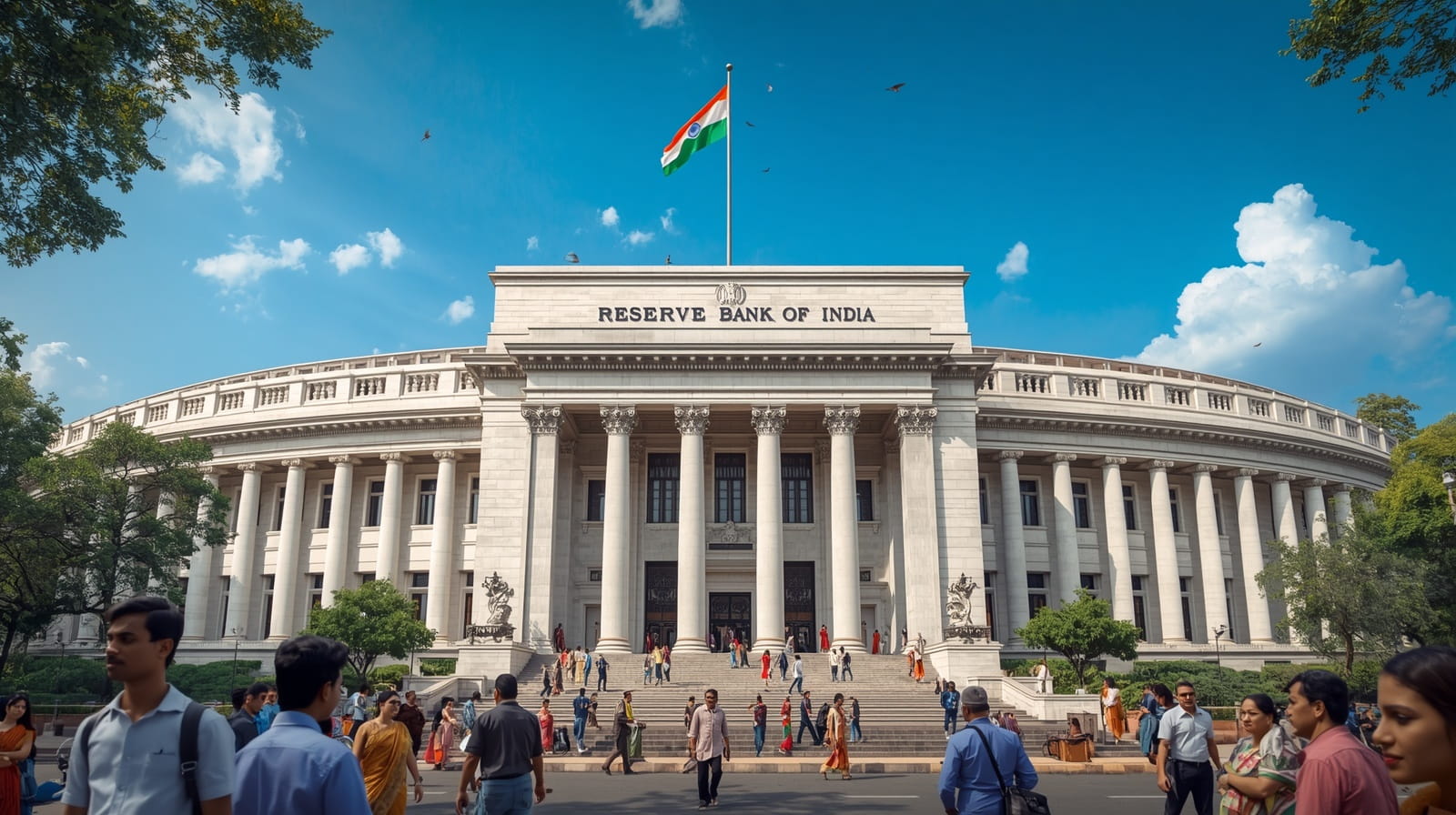

The Reserve Bank of India’s (RBI’s) Monetary Policy Committee has voted unanimously to keep the policy repo rate unchanged at 5.25 per cent, but hiked its real GDP growth forecast for FY2026–27 by 10 bps to 6.7 per cent from 6.6% earlier. The RBI maintained its neutral policy stance, and the market saw that it wants to support economic activity while awaiting greater visibility on inflation as well as external risks.
Repo Rate Remains Unchanged
The decision to hold the repo rate at 5.25% was taken at the MPC meeting held from August 3 to 5, 2026. This is the third consecutive policy review in which the central bank has maintained the benchmark lending rate.
The current policy rates are:
| Policy instrument | Current rate |
| Repo rate | 5.25% |
| Standing Deposit Facility | 5.00% |
| Marginal Standing Facility | 5.50% |
| Bank Rate | 5.50% |
The MPC’s unanimous decision indicates broad agreement among its members that the present level of interest rates is appropriate for the moment.
Growth Forecast Raised
The RBI raised its FY27 real GDP growth forecast to 6.7%, up from the earlier estimate of 6.6%. The central bank cited resilient domestic economic activity and a stronger-than-expected first quarter as key reasons for the upward revision.
The revised quarterly growth projections are:
- Q1 FY27: 7.0%.
- Q2 FY27: 6.4%.
- Q3 FY27: 6.5%.
- Q4 FY27: 6.8%.
The revised projections suggest that the RBI expects the Indian economy to maintain steady momentum throughout the financial year, although growth is likely to moderate after the first quarter.
Why the RBI Paused
The central bank has chosen to remain on hold because the economy is growing at a relatively healthy pace and inflation risks have not disappeared. Cutting rates further could support borrowing and investment, but it could also add pressure if food, fuel or imported commodity prices rise.
Keeping the repo rate unchanged gives the RBI time to evaluate:
- The durability of domestic demand.
- The impact of higher crude-oil prices.
- Weather-related food inflation.
- The movement of the Indian rupee.
- Global interest-rate decisions.
- Geopolitical and trade-related risks.
- The transmission of previous rate changes.
The neutral stance gives the MPC flexibility to respond in either direction depending on how growth and inflation develop.
Inflation Risks Remain
At its latest meeting, the RBI raised its growth outlook but remained watchful of inflation. The central bank cautioned higher oil prices and weather shocks may alter the path for inflation.
Based on the RBI’s August forecasts, FY27 inflation is projected at 5.1% with quarterly forecasts of 5.1%, 5.9% and 5.4% for Q2, Q3 and Q4 respectively
Impact on India: Expensive crude can have a pass-through to fuel prices, transport cost, manufacturing inputs and the import bill. In addition to the price of food, mainly vegetables, cereals and other staples.
Impact on Borrowers
To home-loan, vehicle-loan and business-loan borrowers, the unchanged repo rate offers no relief from policy-driven borrowing costs. However, this will allow banks discretion to change lending rates by their own funding costs, liquidity conditions & competition.
If you have a floating-rate loan, your interest rate is relatively stable unless your bank adjusts its external benchmark or lending spread. Sure, some new loans might be helped by predictable rates but these should not assume a reduction in the rate shortly.
Existing borrowers can use the pause to:
- Review the remaining loan tenure.
- Compare refinancing offers.
- Make partial prepayments where financially suitable.
- Check whether the lender has passed on previous rate changes.
- Negotiate processing fees and spreads on refinancing.
Impact on Depositors
Banks will not face much pressure to cut deposit rates in a stable monetary policy scenario, which means that fixed-deposit investors may notice little change for the time being. But the following deposit rates would also be contingent on banks’ liquidity needs and credit demand.
Savers who value certainty may welcome the rate pause. Investors should look for post-tax returns, period of investment maturity with respect to tenure, if there are rules around premature-withdrawal and also the financial strength of where one is planning to invest.
Impact on Businesses
A stable interest-rate environment provides greater certainty in financial planning for businesses. This allows companies to estimate their borrowing costs more reliably and allows better planning of capital expenditure without a commensurate increase in lending rates immediately.
The upgraded growth outlook is especially relevant for industries such as domestic demand, infrastructure,\ manufacturing,\ financial services and consumer spending. Still, those firms reliant on imported energy and raw materials could find their costs under pressure should global commodity prices stay high.
Market Reaction
A rate pause with a higher growth forecast would, in general, be considered by financial markets as an indication that the central bank views the economy is holding up well. Equity investors might be positive about it especially if the stronger growth supports corporate earnings at higher valuations.
However, bond markets will cling to inflation, government borrowing, liquidity and just global yields. Otherwise, rapidly rising inflation could undermine the bond yield at least temporarily because inflation is often far more powerful than any other influences even before the repo rate was changed.
April 13, 2023 The Indian rupee could similarly be influenced by oil prices, capital inflows or outflows, the US dollar and geopolitics, she said. The RBI’s neutral policy stance thus offers “policy flexibility,” while resorting to liquidity and foreign-exchange operations when required.
Economic Outlook
The RBI’s revised forecast suggests that domestic economic drivers remain relatively strong. Consumption, investment, government capital expenditure and services activity are likely to remain important contributors to growth.
The central bank’s optimism is nevertheless conditional. External shocks could affect the outlook through:
- Higher energy prices.
- Slower global demand.
- Trade disruptions.
- Currency volatility.
- Geopolitical tensions.
- Weakness in major export markets.
India’s growth performance will therefore depend on whether domestic demand can offset external uncertainty.
What the Decision Means
The RBI’s decision sends three broad signals:
- No immediate rate cut: The MPC believes current rates are adequate and does not see an urgent need to stimulate demand further.
- Confidence in growth: The upward revision to the GDP forecast reflects improved confidence in economic activity.
- Continued inflation vigilance: The neutral stance shows that the RBI is not declaring victory over inflation and remains prepared to adjust policy if risks intensify.
Outlook for Future Policy
The next policy decisions will depend heavily on inflation data, oil prices, food supply conditions and the strength of economic activity. A sustained decline in inflation could reopen the possibility of a rate cut, while a renewed price shock could keep rates unchanged for longer.
The RBI is likely to maintain a data-dependent approach rather than provide firm forward guidance. This allows the central bank to respond to changing domestic and global conditions without being locked into a predetermined policy path.
Conclusion
The fact that when the RBI kept rate unchanged at 5.25% but raised FY27 growth projection to 6.7%, reflects some level of cautious confidence on Indian economy by the authority members The central bank sees growth as durable and keeps policy steady, but inflation risks from oil prices, food supply and weather “continue to matter”
The decision offers borrowers stable lending rates in the short term; for businesses, it allows businesses to have better visibility over their costs and for investors reinforces the need to monitor inflationary pressure and global risks. The policy stance remains neutral, so rate decisions will guide the market based on incoming economic data as opposed to a pre-determined easing or tightening cycle.