
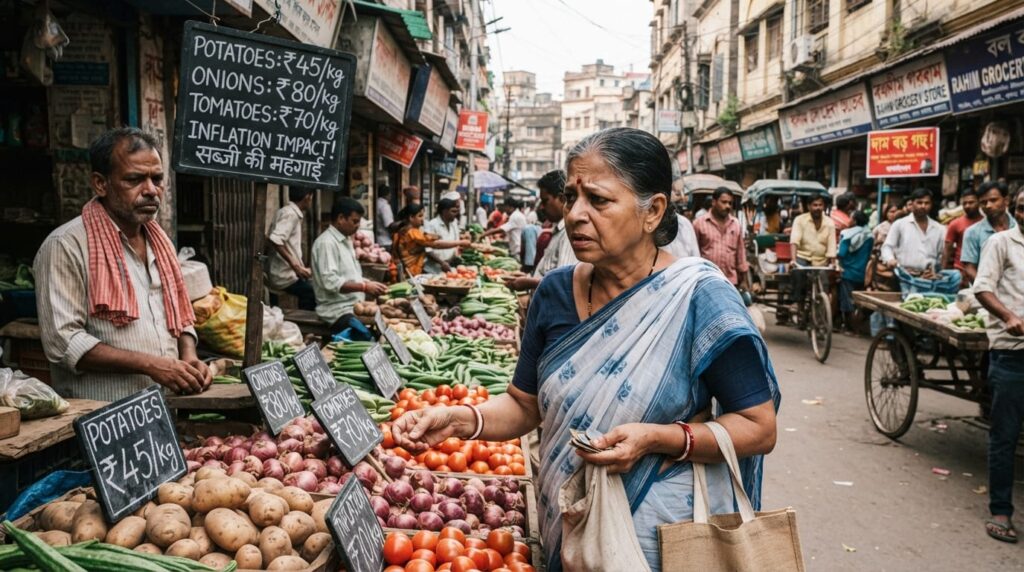

The Reserve Bank of India (RBI) expects headline consumer price inflation (CPI) to rise further in the near term and peak in the third quarter (Q3) of FY27 at around 5.9%, before moderating in the fourth quarter and beyond. The central bank has revised its FY27 average CPI inflation forecast to 5.0% (from 5.1% in June), citing food and fuel pressures as the main drivers, while noting that underlying core inflation remains benign.
RBI’s Inflation Projection for FY27: Quarter‑by‑Quarter
In its August 2026 monetary policy, the RBI laid out a clear quarterly path for CPI inflation:
- Q1 FY27 (April–June 2026): 5.3% (actual)
- Q2 FY27 (July–September 2026): 4.7% (projected)
- Q3 FY27 (October–December 2026): 5.9% (peak)
- Q4 FY27 (January–March 2027): 5.5% (projected)
- Q1 FY28 (April–June 2027): 5.3%
The 5.9% Q3 print places inflation close to the upper end of the RBI’s 2–6% tolerance band, but still below the 6% ceiling.
Why Inflation Is Expected to Peak in Q3
The RBI has been explicit that the Q3 spike is largely a supply‑side, not demand‑side, phenomenon. Governor Sanjay Malhotra emphasized that the rise in inflation is being driven by food and fuel, and has not become broad‑based across the economy.
1. Food Prices
- Vegetables, pulses, and cereals have seen sharp price increases due to:
- Uneven monsoon distribution and heatwave stress on crops
- Base‑effect dynamics from the previous year
- Animal‑protein inflation (meat, fish, eggs) has also contributed to headline CPI.
Food inflation is expected to remain elevated through Q3, especially if monsoon outcomes are patchy or procurement issues persist.
2. Fuel and Energy Pass‑Through
- Elevated crude oil prices, partly linked to West Asia tensions, have raised fuel and transport costs.
- Higher LPG and kerosene prices, along with electricity tariffs in some states, feed into both direct CPI components and indirect costs (logistics, manufacturing).
The RBI expects these second‑round effects from higher fuel and input costs to be most visible in Q3, before gradually easing as global oil markets stabilize and base effects normalize.
3. Core Inflation Remains Contained
Importantly, the RBI sees core inflation (excluding food and fuel) as moderate and contained:
- Core CPI is projected at around 4.7% for FY27.
- There is no evidence so far of broad‑based demand‑pull inflation or a wage‑price spiral.
This distinction is crucial: it means the Q3 peak is viewed as a transitory supply shock, not a structural overheating of the economy.
How the RBI Is Responding: Policy Stance and Tools
Repo Rate on Hold, Stance “Neutral”
In the August 2026 policy, the RBI:
- Kept the repo rate unchanged at 5.25% for the fourth consecutive meeting.
- Retained a “neutral” stance, signaling readiness to act if inflation or growth deviates from the desired path.
The logic is straightforward:
- With growth resilient (FY27 GDP forecast raised to 6.7%), there is no immediate need to tighten policy.
- With inflation expected to peak and then ease, pre‑emptive rate hikes could unnecessarily slow growth.
Liquidity Management and Forward Guidance
The RBI is relying on:
- Liquidity management to ensure money market conditions remain aligned with its policy stance.
- Forward guidance to anchor expectations: by clearly communicating that the Q3 spike is temporary and supply‑driven, it aims to prevent inflation expectations from becoming unanchored.
What This Means for Households, Businesses, and Markets
For Households
- Cost of living pressure is likely to be most visible in Q3 FY27, especially via:
- Higher food bills (vegetables, pulses, cereals, animal protein)
- Elevated fuel and transport costs
- However, with core inflation contained, the RBI expects this pressure to moderate after Q3, assuming no major new shocks.
For Businesses
- Input cost volatility (food, fuel, logistics) may squeeze margins in Q3, particularly for FMCG, logistics, and food‑processing firms.
- Companies with strong pricing power may be able to pass through some costs, but demand sensitivity will vary by segment.
For Investors
- Bond markets: The RBI’s projection of a Q3 peak and subsequent easing supports a view that rates may not need to rise sharply, though yields will remain sensitive to oil and food data.
- Equity markets: Sectors sensitive to input costs and rural demand (FMCG, autos, agri‑linked) may be more volatile around Q3, while financials could benefit from a stable rate path if inflation behaves as projected.
Risks to the Inflation Outlook
The RBI has flagged several risks that could alter the trajectory:
- West Asia conflict escalation – could push crude oil prices higher for longer, increasing fuel inflation and second‑round effects.
- Monsoon variability – a weaker or uneven monsoon could keep food prices elevated beyond Q3.
- Global commodity shocks – disruptions in supply chains or sudden spikes in global food and energy prices.
If these risks materialize strongly, inflation could stay above 6% for longer, forcing the RBI to reconsider its stance.