
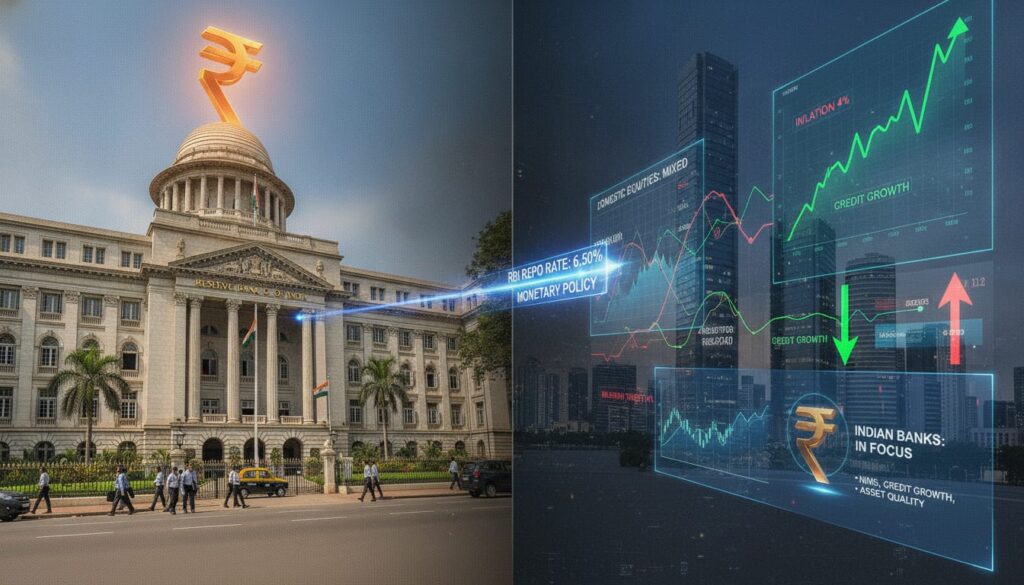

The Reserve Bank of India (RBI) has maintained the repo rate at 5.25% and preserved a “neutral” stance signalling that borrowers will enjoy IMF home loans stability for more time despite banks fighting to protect net interest margins (NIMs) in a competitive deposit environment. This will not lead to an immediate rise in payouts via Equated Monthly Installments (EMIs) on floating-rate, repo-linked loans for their home, auto and personal loans. For lenders, it gives an opportunity to reset deposit pricing and find a balance in funding while avoiding being thrust into rates wars.
What the RBI’s Pause Means in Practice
Repo Rate and Policy Stance
- Repo rate: Held at 5.25% for the fourth consecutive meeting.
- Stance: “Neutral”, signaling that the Monetary Policy Committee (MPC) remains data‑dependent and open to moving rates either way if inflation or growth deviates from projections.
This pause follows a series of cumulative rate cuts of 125 basis points in FY26, which had brought the repo down from 6.50% to 5.25%.
Transmission to Lending and Deposit Rates
- Repo‑linked loans (most new home, auto, and personal loans):
- External Benchmark Lending Rate (EBLR) is tied to the repo, so no immediate change in interest rates or EMIs is expected.
- MCLR‑linked loans (older mortgages, some business loans):
- Can still see adjustments based on banks’ funding costs, liquidity conditions, and deposit mobilization, even if the repo is unchanged.
- Deposit rates:
- Likely to stay broadly stable in the near term, though banks may tweak rates for specific tenures to manage liquidity and competition.
Relief for Borrowers: EMIs Stay Stable, for Now
Floating‑Rate Home, Auto, and Personal Loans
For most retail borrowers on floating, repo‑linked loans, the RBI’s pause translates into:
- No increase in EMIs in the immediate term.
- Continuation of the benefit from the 125 bps of rate cuts delivered since early 2025.
Example impact (illustrative):
- A borrower with a ₹50 lakh home loan at 8.50% (post‑cut) over 20 years pays an EMI of roughly ₹43,400.
- Had the repo been hiked by 50 bps and fully transmitted, the rate could have moved to ~9.00%, pushing the EMI up by around ₹1,500–₹2,000 per month.
- The pause avoids this increase, keeping monthly outflows predictable.
What Borrowers Should Do During the Pause
Financial planners and consumer experts suggest using this stability window to:
- Review loan type:
- Shift from older MCLR‑linked loans to repo‑linked products if the spread is high.
- Consider prepayments:
- Use bonuses, tax refunds, or savings to make partial prepayments, reducing tenure and total interest.
- Check transmission:
- Ensure earlier rate cuts have been fully passed through by the bank; if not, negotiate or consider refinancing.
Banks’ Perspective: Margin Protection in a Tight Deposit Market
While borrowers get relief, banks are focused on safeguarding profitability, especially net interest margins (NIMs), which have been under pressure.
Why Margins Are Under Stress
- Loan rates have repriced faster than deposit rates during the easing cycle, compressing spreads.
- Deposit competition remains intense, especially for term deposits, as banks vie for retail and corporate funds.
- Credit costs and provisioning requirements add to profitability pressures, particularly for lenders with higher exposure to unsecured segments.
S&P Global and other analysts have noted that among India’s largest lenders, many reported sequential NIM compression in late 2025, with only gradual stabilization expected as the rate‑cut cycle pauses.
How the Pause Helps Banks
The RBI’s extended pause offers banks several advantages:
- Greater visibility on loan pricing:
- With lending rates expected to remain broadly unchanged, banks can better forecast interest income.
- Room to recalibrate deposit pricing:
- Banks can adopt a more calibrated approach to deposit rates, avoiding knee‑jerk hikes that squeeze margins.
- Easing liquidity pressures:
- A steady policy outlook and improving liquidity conditions can help moderate funding cost pressures, supporting NIMs.
However, the extent of relief will vary by bank:
- Lenders with strong CASA (current and savings account) ratios and a sticky retail deposit base are better positioned to protect margins.
- Banks heavily reliant on bulk or high‑cost term deposits may still face pressure if competition for funds remains fierce.
The Bigger Picture: Balancing Growth, Inflation, and Financial Stability
The RBI’s pause reflects a delicate balancing act:
- Growth: FY27 GDP forecast raised to 6.7%, signaling confidence in domestic demand and investment.
- Inflation: Expected to peak around 5.9% in Q3 FY27 before easing, driven mainly by food and fuel rather than broad‑based demand.
- Financial stability: Ensuring that banks remain profitable and well‑capitalized so they can continue to support credit growth.
By keeping rates on hold and stance neutral, the RBI:
- Gives borrowers certainty on EMIs, supporting consumption and investment decisions.
- Allows banks time to stabilize margins, reducing the risk of a sharp tightening in credit conditions.
- Retains policy flexibility to react if inflation or growth outcomes diverge from projections.
What Could Change the Picture?
The current “pause and watch” mode is not guaranteed to last indefinitely. Key triggers that could alter the stance include:
- Inflation surprises:
- If CPI stays above 6% for longer or core inflation picks up, the RBI may consider tightening.
- Growth slowdown:
- If growth undershoots forecasts significantly, especially alongside easing inflation, the door could open for rate cuts.
- External shocks:
- A sharp spike in crude oil prices (e.g., from West Asia tensions) or a sudden capital outflow could force a policy reassessment.
For now, though, the baseline is stable rates, stable EMIs, and a focus on margin repair for banks.