
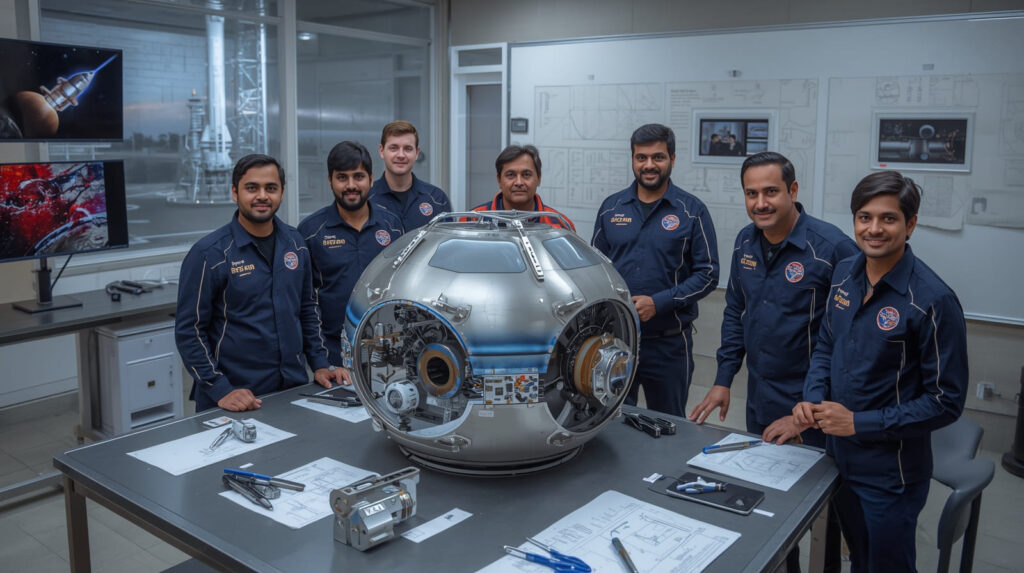

Bengaluru: ISRO has advanced the Bharatiya Antariksh Station (BAS) from broad planning into in-depth design of subsystems. The baseline design review and system engineering for the first module, BAS-01, have been completed, which allows engineers to develop its critical systems, the government told Parliament.
The initial module is expected to launch in 2028, and a full five-module station could be operating by 2035.
Design review completed
ISRO has published 31 baseline design documents for BAS-01, and an expert committee reviewed it. That milestone allows engineers to get down to more detailed work on individual subsystems rather than just the configuration of the station as a whole.
The phase is supposed to encompass the systems necessary for sustaining crew members, scientific operations and future modules whether or not they dock in orbit.
Five-module configuration
The planned station will be assembled progressively in low Earth orbit rather than launched as one large structure. Its five-module configuration is expected to include:
- BAS-01 base module.
- Core and docking module.
- Science-research module.
- Laboratory module.
- Common working or berthing module.
The complete facility is planned to orbit approximately 400–450 kilometres above Earth. It is expected to support a nominal crew of three to four astronauts, with a higher short-duration capacity.
Systems under development
The Bharatiya Antariksh Station will require several technologies that India has not previously operated together in a long-duration crewed orbital facility.
Key systems include:
- Environmental-control and life-support systems.
- Bharat Docking System.
- Bharat Berthing Mechanism.
- Automated hatches.
- Power and thermal-control systems.
- Radiation and micrometeoroid protection.
- Space suits and airlocks.
- Crew habitats and scientific work areas.
- Refuelling provisions.
- Integrated avionics and communications.
The station is also being designed to support microgravity research and technology demonstrations.
Docking technology ready
In the past, ISRO has figured out just how spacecraft would mechanically and electrically dock with station. You’ll need this ability to deliver crew vehicles, cargo spacecraft, and future modules to BAS.
Docking is basically the auto-piloted devices that align spacecraft together, make a structural connection that locks them in place and provide safe transfers of power, data, air and other services. They will be crucial for future missions such as station assembly and crew rotation.
Connection with Gaganyaan
The narrative program is based directly on India’s Gaganyaan human-spaceflight initiative. Indian human rating is manifested in development of the Human Rated Launch Vehicle (HRLV), crew module, escape system, astronaut-support systems along with ground nomenclature as well as recovery operations.
These technologies will underpin the delivery of astronauts to Base Alpha Sabatical (BAS), as well as assist them in orbit. Gaganyaan experience will also assist ISRO in validating systems and procedures related to life support, crew safety and mission control and recovery.
First module in 2028
BAS-01 is expected to become the backbone of the future station. Designed for launch on the LVM3, India’s heaviest rocket, this will weigh around 9–10 tonnes.
The module will serve as a shrink-wrapped on-station environment that contains the basic structural, power, docking and crew-support infrastructures for eventual future expansion. As the programme rolls out, further modules will be released and integrated in phases.
ISRO has opted for a phased approach to gradually try out station operation and stay within the payload tolerances of existing launch vehicles.
Research platform
The BAS is intended to function as an orbital laboratory rather than simply an astronaut habitat. Microgravity research could support work in:
- Materials science.
- Biotechnology.
- Human physiology.
- Fluid dynamics.
- Combustion.
- Plant growth.
- Space medicine.
- In-space manufacturing.
- Robotics.
- Life-support technology.
The station could also serve as a testbed for systems needed during future lunar missions and longer-duration human exploration.
Role of Indian industry
The project’s industrial content is expected to include Indian firms and research institutions for the manufacture of station structures, electronics, life-support systems, docking hardware, avionics and ground equipment.
A domestic supply chain for human-rated space hardware can be fostered through private-sector participation. It could also shorten production timelines and bolster India’s commercial space sector.
Challenges ahead
A space station requires much higher long-term reliability than a conventional satellite or short-duration mission. ISRO must demonstrate that its systems can operate safely for years while supporting astronauts, visiting spacecraft and scientific experiments.
Major challenges include:
- Closed-loop life support.
- Fire detection and emergency response.
- Radiation protection.
- Thermal control.
- Orbital debris protection.
- Autonomous rendezvous and docking.
- Crew health during extended stays.
- Reliable resupply and maintenance.
- Safe integration of future modules.
Each subsystem will require extensive ground testing before being approved for flight.
Strategic importance
The BSAS, it promises to provide India with an independent platform for human spaceflight and microgravity research and technology development. This would decrease reliance on foreign space stations and provide an orbital platform for the US for longer-term missions.
A mutually beneficial Indian manned missionIf a working ISS successor is in place, the facility could also bolster India’s future participation in global human spaceflight projects through international partnership opportunities for joint experiments, astronaut missions based out of the station and technology demonstrations.
Road to 2035
The first BAS module is set to launch in 2028, with the five-module station achieving full operational capacity by 2035.
So the completion date will very much depend on how Gaganyaan goes, the readiness of launch-vehicles, subsystems qualification, funding and successful in-orbit integration of modules.
The start of subsystem-design in detail is a key engineering milestone: India’s space-station goal turns from the plan view to hardware, software and life-support chemicals needed to keep humans alive in orbit.