
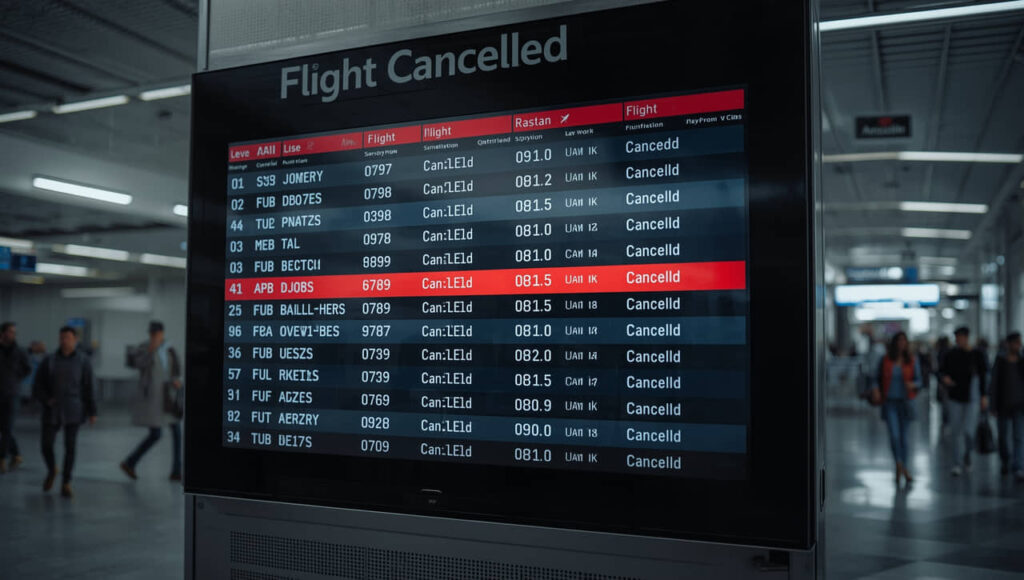

Starting on Friday, flights will be ordered to operate at a 10 percent cutback from current levels at 40 major airports in the United States due to the continued federal government shutdown, which is now in its 36th day and is the longest in U.S. history, according to U.S. Transportation Secretary Sean Duffy. The move is motivated by safety and initiated as the staffing levels of air traffic controllers and Transportation Security Administration (TSA) officers, who have been working without pay since the shutdown began on October 1, have reached crisis proportions.
The measures are intended to ease the burden on approximately 13,000 air traffic controllers and 50,000 TSA employees who have been working under mounting fatigue and stress due to overtime. Airlines now confront the daunting task of grounding thousands of flights in a matter of 36 hours, snarling air travel for passengers across the country. Passenger fears and inquiries to airline call centers have increased, reflecting the chaos surrounding air travel.
The Federal Aviation Administration (FAA) will implement the flight reductions in stages, with a 4% reduction occurring on Friday, followed by a 5% reduction on Saturday and a 6% reduction on Sunday, culminating in the full 10% reduction by next week. This strategy applies only to domestic flights, not international services. The names of the 40 airports have not been officially announced yet. Still, they will likely be dominated by many of America’s busiest airports, including New York City, Washington, D.C., Chicago, Atlanta, Los Angeles, and Dallas.
Bryan Bedford, the administrator of the FAA, insisted that this was unprecedented; nothing like it had occurred in his 35 years in aviation. The determination is predicated on early safety indicators — among them, anecdotal accounts of fatigued controllers — intended to ensure safe airspace management and avert a looming crisis. The flight restrictions will last until staffing stabilizes and the government reopens, Bedford said.
Both Duffy and Bedford said the flight reductions could be undone if the government shutdown, now 20 days old, ends this month. Airlines, in the meantime, are working closely with the FAA to determine how best to apply these cuts, so there is minimal disruption during and after implementation. The combined cutbacks could mean as many as 1,800 fewer flights and more than 268,000 fewer seats nationwide.
The maneuver points to heightened tensions between the Trump administration and Democrats, who it blames for not coming to the table and negotiating a resolution on critical health care subsidies that could end the shutdown. And millions of U.S. travellers have already been affected by flight delays and cancellations due to staffing shortages.
In short, the U.S. government shutdown is making air travel less safe and causing numerous problems. To ease the burden on overworked and underpaid TSA agents and air traffic controllers, 40 major airports have been instructed to reduce their flights by 10% until the shutdown is resolved.