

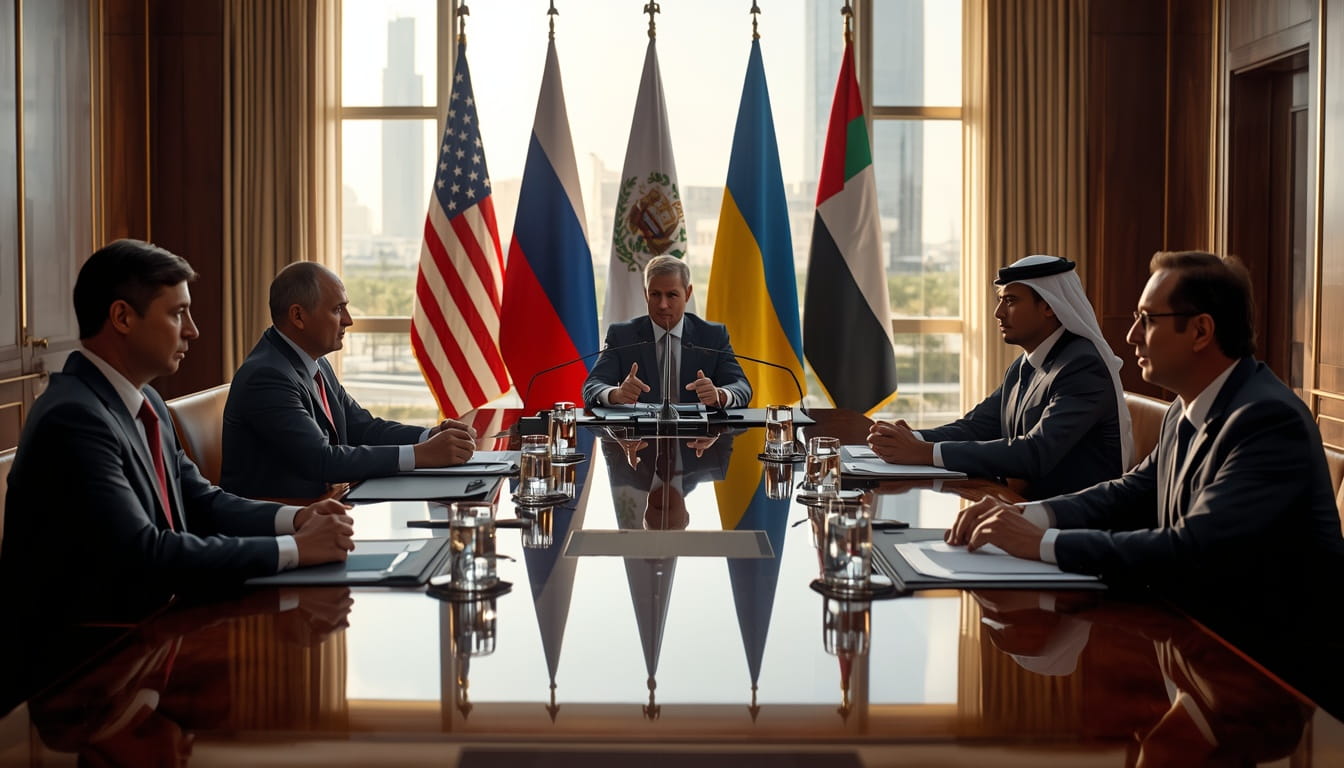

In addition, Russian and Ukrainian negotiators were able to resume face-to-face trilateral negotiations with U.S. mediators in Abu Dhabi on November 10th. This marked the end of a nine month period during which there had been no direct meetings between the three parties. During the initial session, the parties negotiated for approximately four hours. A second day of negotiations is planned for Wednesday, November 11th. While the resumption of negotiations represents a significant step forward in terms of diplomacy, to date, there is no public record indicating that the parties have reached an agreement regarding a cease-fire or a long-term political resolution.
The descriptions of the first meeting of the peace talks as being “very productive” by U.S. Secretary of State Marco Rubio, and “constructive and substantive” by Ukrainian President Volodymyr Zelenskyy, were based upon each official’s own assessment of the day’s events. However, these descriptions do not mean that both parties have begun to reach an agreement regarding the key issues that have perpetuated the ongoing conflict. According to the Associated Press report filed out of Abu Dhabi, prior attempts to facilitate negotiations between Russia and Ukraine in 2023 did not result in any discernible progress towards resolving the conflict.
Humanitarian questions lead the public agenda
The negotiations, according to Zelensky, focused on exchanging prisoners, returning Ukrainian civilians detained in Russia and children abducted from Ukraine. Additionally, security guarantees were discussed. According to an anonymous senior Ukrainian official, the two countries negotiated about a mass prisoner exchange; however, the exact terms will be determined at a later date. This remains a negotiated proposal, but it has yet to result in a successful exchange.
While a major conflict may remain unresolved, humanitarian concerns can provide a more manageable opportunity for action. Agreements concerning exchanges will involve agreeing upon the who, how many, when and how to verify. An agreement made in theory may take a significant amount of time before it is implemented; also, the statements from each party regarding their plans should be compared to the actual results that occur.
Security guarantees remain central
For Kyiv, it is critical that there are security guarantees if there is a cessation in fighting, as there will be questions regarding how future attacks can be prevented. Zelenskyy has urged western allies to provide explicit postwar protections. On the other hand, Moscow has requested a broader debate on European security. According to AP’s reporting of the negotiations and public statements, the U.S. appears to have an interest in a framework that extends outside of Ukraine.
The broader discussion might create diplomatic breathing room, however, it has the potential to complicate an existing negotiation based on Ukraine’s sovereignty and what will be required to end the invasion. According to the Associated Press, Russian Foreign Minister Sergey Lavrov supported the concept of creating a future security architecture prior to resolving the current conflict. However, this is the view of Moscow and not a consensus sequence or common framework.
The battlefield continues to shape diplomacy
The talks come as yet another cold season begins and concerns about attacks on Ukraine’s energy network continue. Attacks against the electrical and thermal infrastructure can have negative effects on civilian populations who are located long distances away from the fighting lines, thus making it imperative for both sides to protect their own infrastructure and provide stable electricity and heat during the cold weather seasons. Simultaneously, both sides’ military decisions will determine how much each delegation will agree to in terms of the negotiations.
The timing of this creates a sense of practical necessity for the humanitarian discussions. There is the possibility of some limited agreements (such as a procedure to exchange prisoners, and/or protections for basic services) being made by both sides; if these were to happen, then some improvement in the situation may be able to occur prior to the resolution of the larger political issue. However, whether or not such limited agreements are implemented depends on access, verification, and the trust that exists between two warring factions. Although there has been success with several past temporary arrangements, none of them alone have resulted in a permanent cessation of hostilities.
The Associated Press reported that the current emphasis on the issue of diplomacy by the U.S. is occurring during an increase in economic pressures on the Russian war machine and during a series of attacks on the Ukrainian electrical system. However, these are merely background factors to consider and not indicators that both sides may now be willing to alter their respective diplomatic positions. It is possible for diplomatic momentum to build and then dissipate rapidly as battlefields shift incentives for the parties involved.
What would count as progress?
The next concrete evidence will be a confirmed prisoner swap; an established humanitarian corridor; or some documented means by which to decrease attacks which will show that there is more to this than just a positive portrayal of a meeting. There are many difficult issues that remain unresolved, such as territorial control, the order in which to implement a ceasefire, sanctions, accountability, and what type of security guarantee will exist in the long term. These issues have not yet been addressed through public statements.
The parties have another reason to be careful with their public statements. If they say the meetings are going well, they may reassure supporters and allow them to continue using diplomatic channels, but this will not tell anyone what was proposed and what was turned down. If they provide a readout that identifies a future date for meetings, working groups, or deadlines for implementing agreements, they may give readers more details. In the meantime, reporters need to separate the facts about delegates meeting from claims regarding the direction of negotiations.
The UAE foreign ministry states that the discussions are a continuation of three-way talks. The ministry’s press release confirms where the talks will take place and who is attending. The ministry’s use of language about creating peace aligns with the stated goals of the UAE government. The official press release from the UAE foreign ministry officially confirms these details.
For the individuals impacted by the conflict, the distance between the time spent negotiating and providing aid is instant. A meeting does not restore electricity to a home, reunite a family member who has been taken captive, or provide safety during travel. However, a meeting does provide a means to develop some form of agreement. The success of the Abu Dhabi negotiations will depend upon if the discussions result in verifiable actions and if those actions can continue to function under the strain of a conflict that has continuously outlasted all diplomatic optimism.
The outcome of the negotiations will be evaluated based upon how inclusive they were and whether or not they are going to last. The European Union has a vested interest in the security arrangements that are currently being negotiated, as well as civilians and families affected by the captivity of their loved ones. If the negotiations discuss a larger security arrangement, then those participating countries will require the details of that arrangement to be specific enough to understand what role each country will play. Announcements made regarding security arrangements with no specification of who will be responsible for providing the security may result in no changes to the risk associated with the situation.