

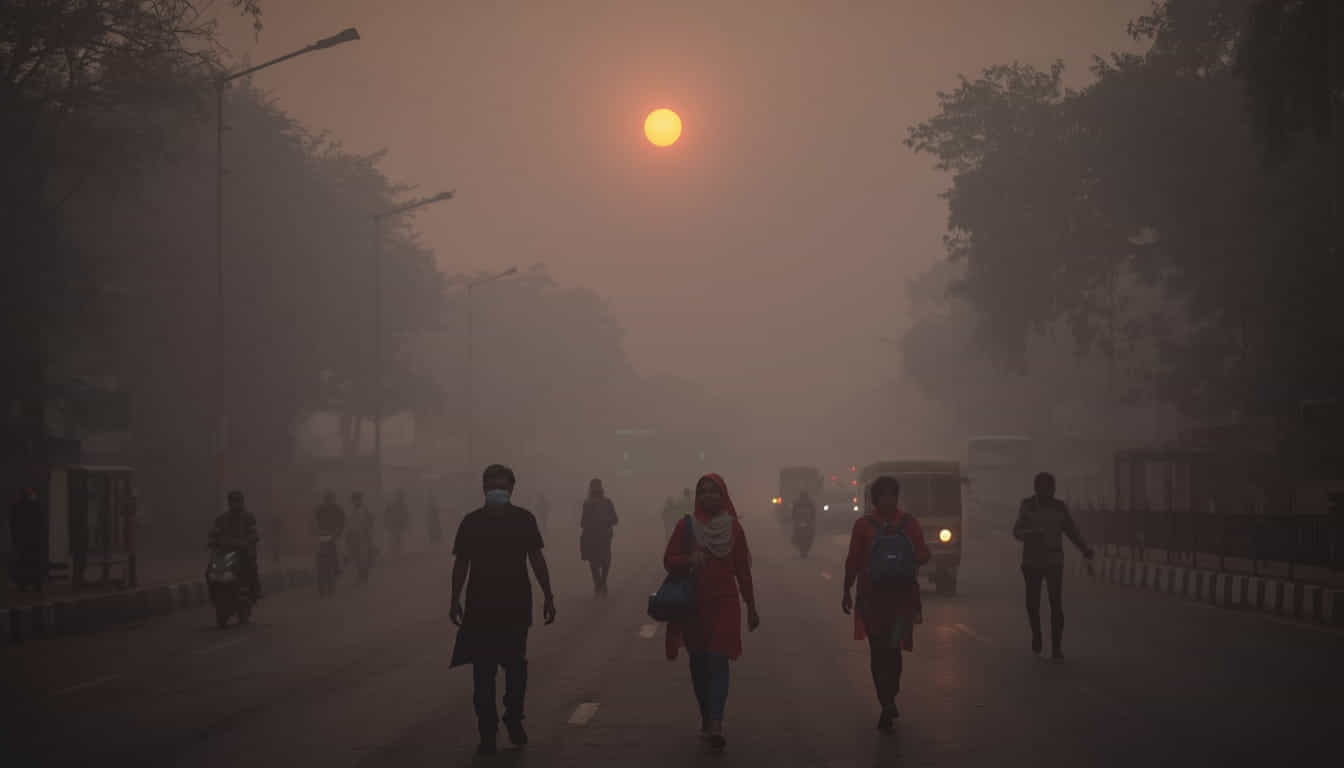

Parts of Delhi entered the “Severe” air-quality category in the early hours of November 9, the morning after Deepavali. The Central Pollution Control Board (CPCB) station at ITO recorded an AQI of 406 at around 4:20 a.m.
The report described thick smog and reduced visibility in several parts of the capital. Readings varied by location: Rajiv Chowk recorded an AQI of 381 at 1:30 a.m., while South Extension registered 360 at 4 a.m.
AQI values are reported by monitoring station and time, so one station’s reading does not describe conditions across the entire city.
Particulate pollution readings
The report also cited Delhi Pollution Control Committee data showing PM2.5 at 760.99 micrograms per cubic metre in Akshardham at 11 p.m. on November 8.
That was a short-term measurement. It should not be confused with a 24-hour average or directly treated as the same measure as a 24-hour health guideline. The reading nevertheless indicates a sharp pollution spike at that monitoring location and time.
Deepavali firecrackers were one factor discussed in coverage of the overnight pollution. Weather, traffic and other emissions also affect air quality, and their contribution can vary across neighbourhoods and hours.
Restrictions and public response
The Hindu reported that Stage III of the Graded Response Action Plan (GRAP) was in force across Delhi-NCR. The Supreme Court had permitted approved firecrackers subject to specified timings for the festival, with the report noting a 10 p.m. deadline.
Air-quality readings can change through the day as wind and weather conditions shift. Monitoring stations provide local measurements that help authorities track the situation and decide whether additional restrictions are needed.
Why the numbers need context
The AQI scale groups pollution readings into categories to communicate air conditions. A “Severe” classification signals very high pollution, but exposure can differ depending on where a person is and how long they remain outdoors.
A citywide discussion should therefore distinguish between a specific station reading, a particular pollutant measurement and a daily average. These figures answer different questions and should not be treated as interchangeable.
What to watch next
The immediate question is whether readings ease as the day progresses and weather conditions change. Authorities and residents will also be watching for further measurements across Delhi-NCR, since pollution levels can vary substantially between locations.
The post-festival readings renew attention on the challenge of managing seasonal pollution in a large city. Data from monitoring stations can help show where conditions are worst and whether interventions are making a difference over time.