
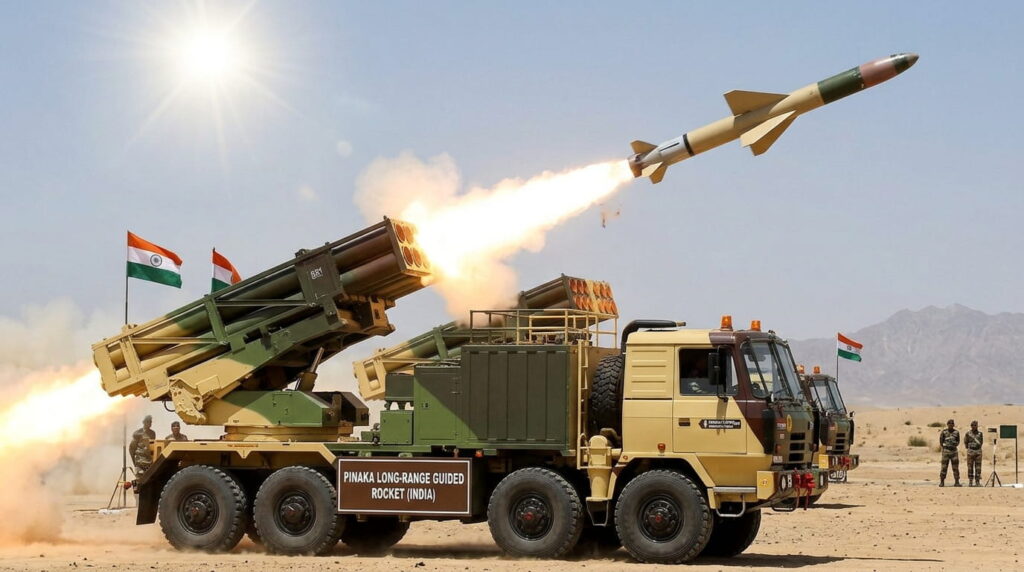

India has successfully conducted a flight test of the Pinaka Long Range Guided Rocket (LRGR), marking a major advancement in the country’s indigenous precision-strike and rocket-artillery capabilities. The trial was conducted by the Defence Research and Development Organisation (DRDO) at the Integrated Test Range in Chandipur, Odisha.
Successful Flight Trial
The rocket flew to its promised range of an estimated 120 kilometres, and executed all pre-flight as well as in-flight manoeuvres. It then subsequently hit the intended target with “textbook precision,” according to the DRDO.
The rocket was tracked throughout its flight trajectory by range instruments placed along the flight path, enabling engineers to evaluate key performance characteristics in its guidance and terminal accuracy.”
The successful conducting also validated the ability of the rocket to hit long ranges while retaining accuracy, improving operational capability of Pinaka family multiple barrel rocket launcher.
Existing Pinaka Launcher Used
One of the most important aspects of the test was that the LRGR was launched from an in-service Pinaka launcher. This demonstrates that the Indian Army may be able to introduce the longer-range guided rocket without completely replacing its existing launcher fleet.
The compatibility provides several operational and logistical advantages:
- Existing launchers can be used for multiple Pinaka variants.
- The Army can upgrade its strike capability at lower cost.
- Training and maintenance requirements can remain broadly familiar.
- Units can select rockets according to range and mission requirements.
- The same launcher architecture can support both conventional and guided rockets.
This flexibility could allow the Army to combine area-saturation fire with more accurate long-range strikes.
Development of LRGR 120
Developed by DRDO, the LRGR 120 rocket was a joint design between Armament Research and Development Establishment (ARDE) B01 appeared first on Defenceaviationpost.com. Technical support was also provided by Defence Research and Development Laboratory, Research Centre Imarat.
The flight trial was conducted by the Integrated Test Range and test and evaluation was done by the Proof and Experimental Establishment. The positive outcome celebrates the combined effort of organisations designing missiles, vehicle propulsion, telemetry and other range-instrumentation centres in India.
The system is intended to give the Indian Army a long-range guided rocket with precisionsought in target engagement than unguided artillery rockets.
How It Differs from Conventional Rockets
Standard artillery rockets are created mainly to blanket a target area with multiple rounds in one go. Guided missiles are those that include some sort of navigation and control systems, which in turn enable them to correct their flight path, making their impact more precise.
Inertial navigation, mid-course updates and terminal guidance are the key technologies associated with Pinaka LRGR. These systems reduce launch errors, wind and other things that make it difficult to make an accurate flight.
A guided rocket can therefore be used against targets such as:
- Command and control centres.
- Ammunition and logistics depots.
- Air-defence positions.
- Artillery batteries.
- Communication nodes.
- Concentrated military formations.
- Other high-value battlefield targets.
Indigenous Defence Technology
The trial supports the government’s Aatmanirbhar Bharat initiative by demonstrating India’s ability to design and develop a long-range precision rocket domestically. The Pinaka system was originally developed as an indigenous alternative for delivering rapid and concentrated artillery fire.
The successful LRGR trial strengthens India’s domestic capabilities in several areas:
- Rocket propulsion.
- Guidance and navigation.
- Warhead integration.
- Flight control.
- Precision strike technology.
- Test-range tracking and evaluation.
The development of indigenous systems also gives the armed forces greater control over upgrades, production and future variants.
Strategic and Operational Significance
An onboard 120 km guided rocket would expand the range of Indian Army artillery units further than what previous Pinaka versions could offer. It could help commanders strike key targets deeper in enemy territory while lowering the number of rockets needed to achieve a certain level of destruction.
The system could also increase survivability by allowing launcher units to shoot from farther away from enemy forces and quickly relocate after firing. The ability to fire a tool and then scoop it away is an essential characteristic of contemporary rocket artillery, boosting the prospects for minimizing casualty from counter-battery fire.
The LRGR is not a middle-range ballistic missile or cruise missiles substitute. Instead, it plays a battlefield- and theatre-level role as an alternative to relatively affordable and mobile precision-fire systems.
Expanding the Pinaka Family
The Pinaka family shifted from being an area-saturation rocket system to a wider range of weapons with various ranges and guidance. In earlier variants, these consisted of extended-range rockets while guided counterparts were engineered to increase precision.
The recent long-range guided variant may achieve a strike range of up to 120 km and be launched from within the confines of existing Pinaka launcher architecture.
This development gives the Indian Army the ability to operate a mixed inventory of rockets, combining:
| Capability | Operational purpose |
| Unguided rockets | Rapid saturation of large target areas |
| Extended-range rockets | Engagement of targets at greater distances |
| Guided rockets | Precision attacks against high-value targets |
| Long-range guided rockets | Deep strikes with improved accuracy |
Minister Congratulates DRDO
Defence Minister Rajnath Singh congratulated DRDO and others involved in the successful test. While calling the development of long-range guided rockets a significant accomplishment, he asserted that the capability would bolster the strength of Armed Forces.
The DRDO Chairman and Secretary of the Department of Defence Research and Development (R&D), Dr Samir V. Kamat, also witnessed the trial and congratulated the teams for carrying out mission objectives successfully.
Future Induction
Achieving a successful flight test is an important milestone but usually additional testing is needed before a weapon system is ready for large scale manufacturing and operational induction. This could involve tests under different weather and terrain conditions, multiple-range firings, as well as salvo launches and even the evaluation of production-standard rockets.
Final induction could also be subject to an assessment of the rocket’s reliability, mobility, storage life, warhead performance and compatibility with existing fire-control systems.
Conclusion
This test of the Pinaka Long Range Guided Rocket was a major milestone for India’s Indigenous Rocket-Artillery. It has a proven range of over 120 kilometres, guidance precision and the ability to utilize the existing Pinaka launcher to provide the Indian Army with a flexible and low-cost long-range strike capability.
Which brings us to the trial — and perhaps more significantly, the growing maturity of India’s defence-industrial ecosystem. And as LRGR development marches on and user trials carry on, the LRGR might just be a critical element of modern Indian artillery and precision-fire strategies.