

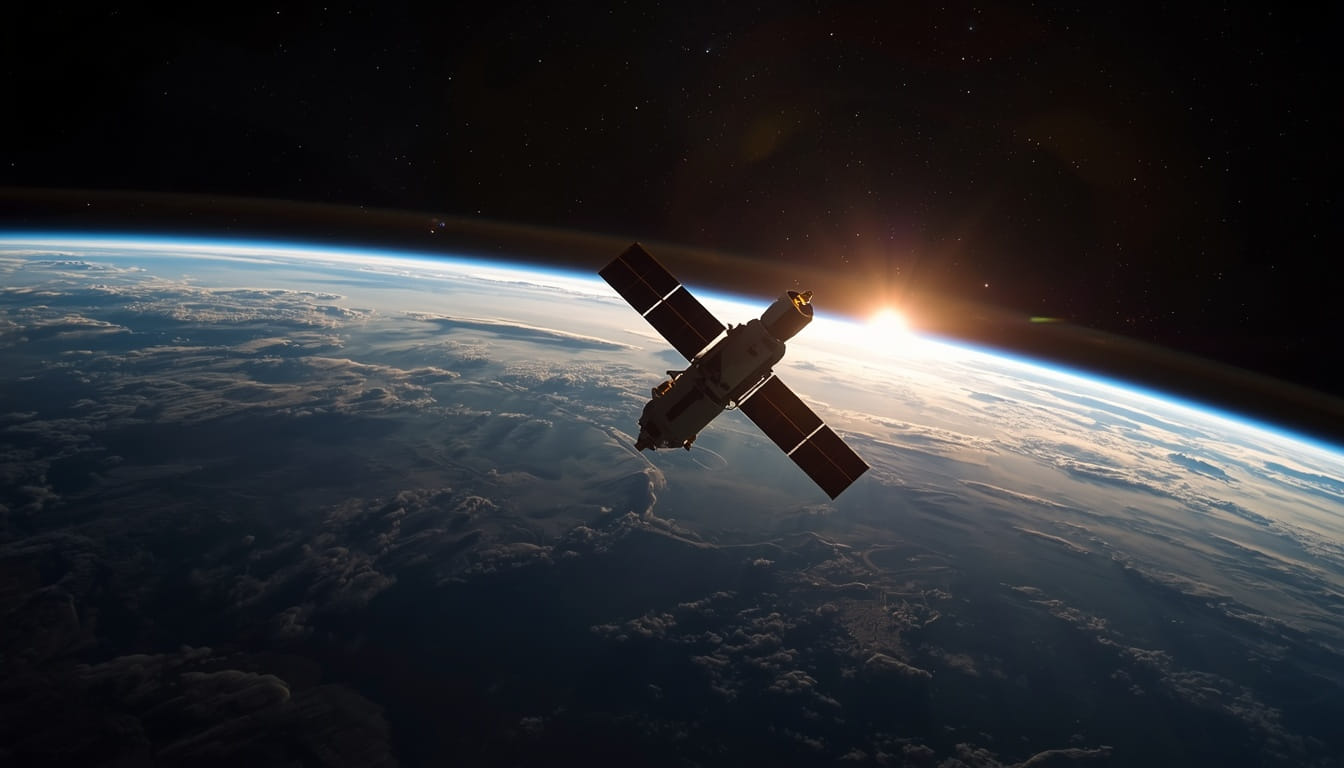

NASA’s Neil Gehrels Swift Observatory is expected to re-enter Earth’s atmosphere on November 4, 2026, bringing an end to a mission that has studied some of the universe’s most energetic events for almost 22 years.
The observatory was launched in November 2004 to investigate gamma-ray bursts, among the most powerful explosions in the cosmos. It was originally designed for a two-year primary mission, but continued operating for far longer and became an important part of international astronomical research.
NASA said the roughly 3,200-pound spacecraft was expected to re-enter the atmosphere on Wednesday, November 4. The United States Space Force’s forecast, published by NASA on November 2, estimated a re-entry time of approximately 3:30 a.m. Eastern Standard Time, with an uncertainty of 11 hours.
The forecast is not a precise prediction. NASA and the Space Force said they would continue monitoring the spacecraft and updating their estimates.
What is the Swift observatory?
The Neil Gehrels Swift Observatory is a space-based telescope designed to study gamma-ray bursts and other high-energy astronomical events.
Gamma-ray bursts are brief but extremely energetic flashes of gamma radiation. They are associated with some of the most violent events in the universe, including the collapse of massive stars and the merger of compact objects.
Swift was built to detect these bursts quickly and coordinate observations using multiple instruments.
The observatory carries three telescopes that examine different parts of the electromagnetic spectrum: the Burst Alert Telescope, the X-Ray Telescope and the Ultraviolet/Optical Telescope.
This multiwavelength design allows scientists to study an event using different kinds of light. When Swift detects a gamma-ray burst, its systems can rapidly direct its other instruments towards the source and collect additional observations.
The spacecraft can also send alerts to other observatories, allowing researchers on Earth and in space to conduct follow-up observations.
A mission that lasted far beyond its original plan
Swift launched in 2004 with a planned primary mission of two years. Its continued operation over almost 22 years gave astronomers an extensive record of high-energy events.
NASA has described the observatory as a versatile scientific platform. Over its operational lifetime, Swift studied gamma-ray bursts, supernovae, active galaxies, stars affected by black holes, comets and asteroids.
The spacecraft’s rapid response capability was particularly valuable. Some astronomical events change quickly, meaning researchers need to observe them soon after they occur.
Swift’s ability to detect an event and rapidly point its instruments towards the source helped scientists collect information that might otherwise have been missed.
The mission also contributed to a large archive of observations that can continue to support research after the spacecraft stops operating.
Why is Swift returning to Earth?
Satellites in low Earth orbit gradually lose altitude because of atmospheric drag. Although the atmosphere is extremely thin at orbital heights, it still produces resistance that can slow a spacecraft and reduce its orbit over time.
Solar activity can influence the density of the upper atmosphere. When atmospheric density increases, satellites at low altitudes can experience greater drag.
NASA said recent solar activity had increased the drag affecting Swift and contributed to its faster orbital decline.
The mission team had attempted to extend the spacecraft’s life through a commercial servicing effort intended to boost it into a higher orbit. That effort did not result in the planned orbit-raising operation.
NASA said Swift’s science operations ended after the spacecraft descended to a height where atmospheric drag made it difficult for the observatory to continue pointing its telescopes steadily at astronomical targets.
The mission conducted its final observation on October 20, 2026, according to NASA’s earlier mission update.
What will happen during re-entry?
As Swift descends into the denser layers of Earth’s atmosphere, friction and heating will cause most of the spacecraft to burn up.
NASA expects most of the observatory to disintegrate during re-entry, although some components may survive and reach the surface.
The precise location of any surviving debris depends on the spacecraft’s actual re-entry time and trajectory.
NASA said Swift’s low orbital inclination limits the possible re-entry region for surviving fragments to between 20.6 degrees south latitude and 20.6 degrees north latitude.
That broad band includes parts of several continents and large areas of ocean. It does not mean that debris is expected to land in any particular country or location.
NASA cited an estimated risk of harm to anyone on Earth of approximately one in 2,100. The agency described the risk as unlikely and said it would continue to coordinate with the U.S. Space Force.
The published forecast included an 11-hour uncertainty range. Readers should therefore treat the stated time as an estimate rather than a confirmed moment of re-entry.
The failed attempt to extend the mission
The planned orbit-raising effort was intended to give Swift additional time in space.
NASA previously described a commercial servicing mission that was intended to capture the spacecraft and move it to a higher orbit. The attempt did not achieve the planned boost, and the mission was not able to restore Swift to a higher operational orbit.
The observatory’s subsequent return to science observations was limited by its declining altitude and increasing atmospheric drag.
The episode illustrates one of the challenges facing ageing spacecraft: a satellite may remain scientifically valuable even when its orbit and hardware make continued operations difficult.
It also highlights the growing interest in commercial satellite servicing, a field that could support future efforts to inspect, repair, refuel or reposition spacecraft.
Swift’s attempted rescue did not extend the mission as intended, but the wider challenge of maintaining satellites in orbit remains an important area of space technology development.
What Swift leaves behind
The end of Swift’s mission does not mean the end of its scientific contribution.
The observatory has produced a substantial archive of multiwavelength observations. Researchers can continue analysing this data to study cosmic explosions, black holes, galaxies and other astronomical objects.
NASA has emphasised the long-term value of the mission’s observations. Scientific archives can remain useful for years because new analytical methods and discoveries may allow researchers to revisit older measurements.
Swift also demonstrated the value of rapid-response astronomy. By detecting short-lived events and quickly directing instruments towards them, the observatory helped establish an approach that remains important to modern astrophysics.
A significant end to a long-running space mission
Swift’s expected return to Earth marks the conclusion of a mission that substantially exceeded its original two-year plan.
Its three telescopes helped astronomers observe high-energy events across multiple wavelengths, while its rapid alert system supported follow-up observations by other facilities.
The spacecraft’s re-entry is a routine consequence of orbital decay, although the final event is being monitored because some components may survive the journey through the atmosphere.
For NASA and the wider astronomy community, the mission’s end is also an opportunity to recognise the scientific record it leaves behind.
Swift may no longer be able to observe the universe, but its archive will continue to support research into some of the most energetic phenomena known to science.