
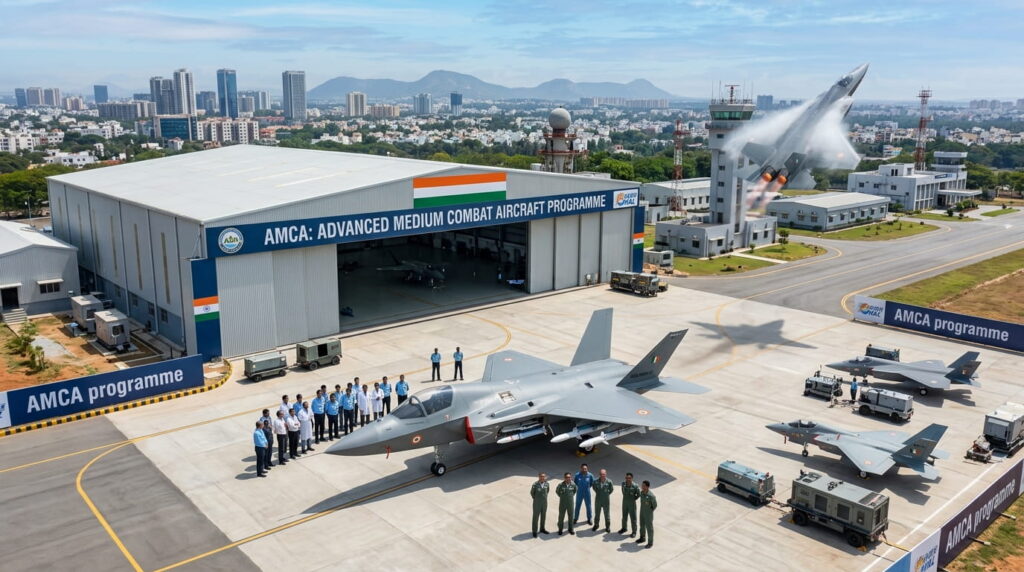

India has taken a major step toward developing its first indigenous fifth-generation stealth fighter by inviting bids for the Advanced Medium Combat Aircraft (AMCA) programme. The nearly ₹15,000-crore development phase will cover five flying prototypes, a structural test aircraft and the manufacturing and testing ecosystem required for the future fighter.
Programme Enters Competition Phase
The Aeronautical Development Agency, under the Defence Research and Development Organisation, has issued a Request for Proposals to shortlisted Indian companies and consortia. The contenders are:
- Tata Advanced Systems Limited, bidding independently.
- Larsen & Toubro, in partnership with Bharat Electronics Limited and Dynamatic Technologies.
- Bharat Forge, in partnership with BEML and Data Patterns.
The selected industry partner will work with the ADA on prototype development, flight testing and establishing a production line. The contract is expected to be finalised after technical and commercial evaluation, with negotiations targeted for early 2027.
Five Prototypes Planned
Five of each flying prototypes and one structural test specimen are anticipated as part of the AMCA development programme. Collier says the planes will be involved in ground testing, taxi trials of military and civilian ordinance aircraft compatible with the design, flight evaluation, weapons integration and certification.
An estimated 1,800 sorties will comprise the remainder of the flight-test campaign. Prior to multirole operational clearance (MOC), testing will assess the aircraft’s aerodynamics, stealth features, propulsion, flight-control system, sensors and weapons/mission systems.
Under the current schedule, the first prototype could start taxi tests and make its first flight about 30 months after the contract is awarded for development. First flight is now scheduled for approximately 2029, with full development and certification expected to stretch into the early 2030s.
Planned Fighter Configuration
The AMCA is being developed as a single-seat, twin-engine, all-weather multirole combat aircraft. Its design is expected to include:
- Low-observable stealth shaping.
- Internal weapon bays.
- Supercruise capability.
- Advanced avionics and sensor fusion.
- Artificial-intelligence-assisted mission systems.
- High-altitude operating capability.
- Reduced radar, infrared and electronic signatures.
- Capability to carry weapons internally and externally.
Internal weapon carriage is central to the aircraft’s stealth design because it reduces radar reflections compared with carrying missiles and bombs on external pylons. External hardpoints may still be used when maximum payload is more important than low observability.
Engine Development
The General Electric F414 is likely to power the first prototypes of the AMCA Mk-1. This would enable India to commence flight testing, even as a more powerful engine for later variants is developed. youtube
Eventually, the aim is to design and build a home-grown, or co-developed engine for an AMCA Mk-2. If the aircraft is to reach the performance needed for supercruise, heavier payloads and shorter take-off distances, a more powerful powerplant will be important.
Among the biggest technical challenges faced by the programme is development of an engine. India’s earlier fighter projects reveal that propulsion, flight-control software, stealth manufacturing and systems integration can be major contributors to the development timelines.
Two-Phase Development
The AMCA is generally planned in two broad stages:
| Variant | Expected role |
| AMCA Mk-1 | Initial fifth-generation configuration, expected to use the GE F414 engine |
| AMCA Mk-2 | More advanced version with a higher-thrust engine developed through Indian and foreign collaboration |
The first two Indian Air Force squadrons are expected to be formed with the initial configuration, while later squadrons would use the improved Mk-2 variant. The long-term plan is reported to involve at least six squadrons and more than 120 aircraft.
Manufacturing Model
The AMCA aims to establish an industry-partnership model with India private sector taking the lead on development and production of such projects under government oversight. Earlier fighter programmes were dominated by state-controlled Hindustan Aeronautics Limited and this was a departure from that.
The chosen firm will be required to assist with the entire development process, including prototype construction, testing and certification along with building a production line for serial supply. The specific purpose of this model is to attract larger private investment, to enhance the manufacturing productivity and broaden India’s aerospace industrial base.
An independent facility for integration and flight-testing is also being set up in the state of Andhra Pradesh, which will complement the aircraft programme. This will be necessary for final assembly, systems integration and ground testing of flight-test operations.
Importance for the Indian Air Force
The AMCA is intended to become India’s principal advanced fighter platform from the mid-2030s onward. It would complement rather than immediately replace existing aircraft such as the Su-30MKI, Rafale, Tejas and future Tejas Mk2.
The fighter could provide the Indian Air Force with improved capabilities in:
- Air superiority.
- Deep-penetration strike.
- Suppression of enemy air defences.
- Maritime strike.
- Electronic warfare.
- Network-centric operations.
- Precision attacks against high-value targets.
Its stealth and sensor-fusion capabilities could allow it to detect and engage threats while reducing the probability of being detected first.
Strategic Significance
India is currently dependent on foreign-origin aircraft for much of its advanced fighter capability, making the AMCA strategically important. Indian fifth-generation jets made onshore using indigenous technology would substantially reduce long-term reliance on foreign businesses while providing India with control over upgrades, weapons integration and operational availability.
The aircraft would also bolster India’s capacity to respond to the rapid development of advanced combat aircraft in the region. With fifth-generation fighters already in the air and operational service, China is piling the pressure on regional air forces to develop similar capabilities.
Beyond the aircraft itself, the programme could create expertise in:
- Stealth materials and coatings.
- Advanced engine technology.
- Active electronically scanned array radars.
- Infrared search-and-track systems.
- Electronic-warfare suites.
- Flight-control software.
- High-precision aerospace manufacturing.
- Low-observable maintenance.
Development Challenges
The AMCA programme faces several challenges that could affect cost and delivery schedules:
- Developing a suitable high-thrust indigenous engine.
- Maintaining low radar signatures across production aircraft.
- Integrating sensors, electronic warfare and weapons.
- Achieving consistent manufacturing quality.
- Completing large-scale flight testing on schedule.
- Establishing a reliable supply chain for specialised components.
- Controlling development costs while meeting performance targets.
A stealth fighter is considerably more complex than a conventional fourth-generation aircraft. Its effectiveness depends not only on its shape but also on materials, panel alignment, engine treatment, thermal management, electronic emissions control and software integration.
Expected Timeline
The currently reported roadmap is broadly as follows:
- Prototype development contract: targeted around early 2027.
- First prototype: approximately 30 months after contract signing.
- Maiden flight: around 2029, subject to programme progress.
- Additional prototypes: progressively through the early 2030s.
- Flight testing and certification: expected to continue until about 2034.
- Serial production: targeted for the mid-2030s.
- Indian Air Force induction: expected around 2035 if the schedule holds.
These dates remain targets rather than guaranteed milestones. Complex fighter programmes often experience changes because of engine availability, testing results, technology development and production-readiness issues.
Conclusion
The AMCA is transitioning from designing and planning to a competitive prototype-development stage, with Indian industry groups shortlisted by DMDE for competing in the ₹15,000-crore project. The program will develop an indigenous 5th– Generation fighter aircraft (NGEF) for India capable of internal weapons carriage, advanced sensors, supercruise and networked combat systems.
If development continues on its current schedule, the first aircraft might fly by 2029 and, some time in the mid-2030s, it would enter service with the Indian Air Force. If successful it would mark a huge step forward for India’s aerospace sector and give the nation far more autonomy in designing, manufacturing and upgrading next-generation combat aircraft.