
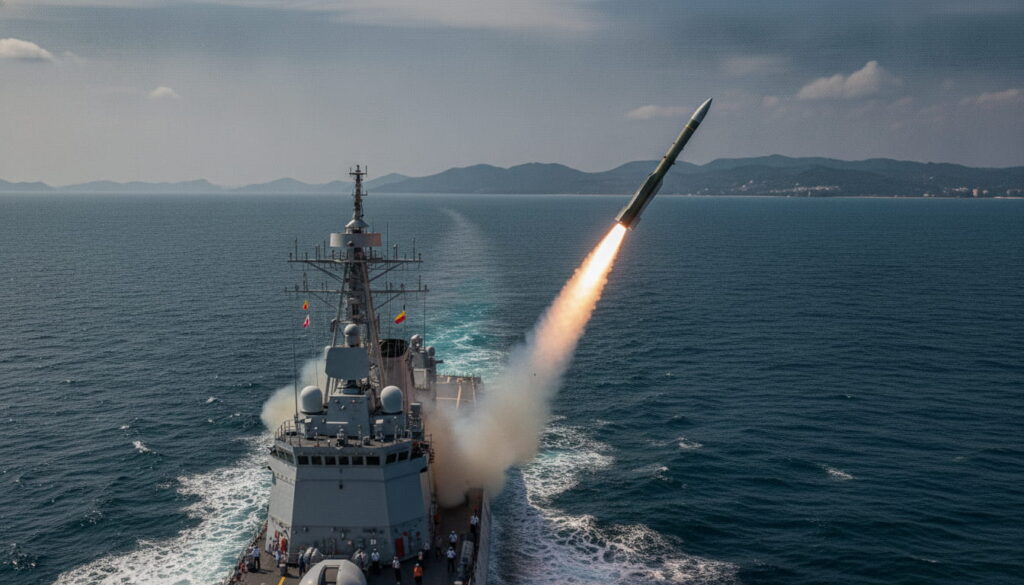

India has also increased the specified missile-test restricted area in the Bay of Bengal and Indian Ocean region to around 3,760 kilometres (2,335 miles) from an earlier notification for a range of around 2,530 kilometres. The updated airspace and maritime warning is associated with a long-range missile test on August 6–7, 2026.
What the Notification Says
The updated Notice to Airmen, or NOTAM, reportedly establishes a temporary restricted corridor extending from the Dr. APJ Abdul Kalam Island test facility off Odisha toward the southern Indian Ocean.
The notification serves two purposes:
- It keeps civilian aircraft away from the missile’s projected flight path.
- It warns commercial and military shipping to avoid the designated maritime zone.
- It allows the Indian Navy, Air Force and test authorities to monitor the area safely.
- It reduces the risk of accidents involving missile stages, debris or tracking activity.
A NOTAM does not itself identify the missile being tested. It primarily indicates the location, timing and approximate safety requirements for an operation.
Range Extended from 2,530 to 3,760 Km
The most significant development is the increase in the declared test corridor. The earlier advisory reportedly covered approximately 2,530 kilometres, while the new notification extends the potential trajectory to nearly 3,760 kilometres.
Such an expansion could reflect several possibilities:
- A longer-range missile flight.
- A different launch or impact point.
- A test involving a higher-energy trajectory.
- Evaluation of missile stages, re-entry systems or guidance equipment.
- A requirement for a larger debris and tracking zone.
The size of a NOTAM zone should not be treated as the confirmed operational range of a missile. Authorities often establish a larger safety corridor than the expected impact point because of trajectory uncertainty, debris dispersion and the need to protect civilian traffic.
Which Missile Could Be Tested?
Both the Indian government and the Defence Research and Development Organisation did not go official with what specific missile system was concerned. But the size of the new range has also led to speculation about it being an advanced Agni-series missile, as well as a SLBM.
India has previously declared very substantial Bay of Bengal exclusion zones for strategic missile tests. A further NOTAM in May 2026 extended across a corridor of around 3,550 kilometres with defence sources indicating that the flight profile was consistent with that achieved by the Agni-IV intermediate-range ballistic missile system which has been reported to have an approximate range of similar dimensions.
The latest 3,760-kilometre corridor could therefore be associated with:
- An Agni-series ballistic missile.
- A technology-demonstration vehicle.
- A re-entry or hypersonic test platform.
- A submarine-launched ballistic missile-related trial.
- A developmental system whose exact specifications remain classified.
These possibilities remain unconfirmed until the Ministry of Defence issues an official statement.
Importance of the Agni Programme
At present, Agni family is the mainstay of India’s land based strategic missile. Several variants are designed for different range categories and numerous advancements in propulsion, accuracy, mobility and guidance as well as improved solid rocket burnout characteristics have been made over the years.
Commonly said to have a range of around 3,500–4,000 kilometres, the Agni-IV is a two stage solid-fuelled ballistic missile. It is said to be able to carry a warhead with a weight of up to 1,000 kilograms also.
A successful trial involving an Agni-class system would help validate:
- Propulsion performance.
- Navigation and guidance systems.
- Flight-control software.
- Heat-shield and re-entry performance.
- Communication between launch, tracking and command systems.
- Operational readiness of the missile and its support infrastructure.
For strategic weapons, testing is not limited to proving whether a missile can fly. It also helps confirm reliability across the entire launch chain, including transport, preparation, command authentication, telemetry and post-launch tracking.
Strengthening India’s Nuclear Triad
The notification also has significance in the context of India’s nuclear triad—the ability to deliver nuclear weapons from land, air and sea.
India’s strategic forces include:
- Land-based ballistic missiles from the Agni family.
- Aircraft capable of delivering strategic weapons.
- Nuclear-powered ballistic-missile submarines equipped with submarine-launched ballistic missiles.
A sea-based deterrent is particularly important because submarines can operate covertly and are more difficult for an adversary to locate and neutralise. India’s K-4 submarine-launched ballistic missile is frequently discussed in connection with the country’s effort to strengthen the sea leg of its nuclear deterrent, although there is no official confirmation that the current August trial involves that system.
Why the Bay of Bengal Is Used
The Bay of Bengal offers India a large open-water corridor for missile testing. Launch facilities on or near Odisha’s coast allow test vehicles to travel over the sea without crossing densely populated land areas.
The region provides several advantages:
- A direct launch path from India’s eastern missile-test facilities.
- Deep ocean areas suitable for impact zones.
- Space for naval tracking ships and radar systems.
- Reduced danger to civilian populations.
- Access to the wider Indian Ocean for long-range trials.
India’s primary missile-test infrastructure includes the Integrated Test Range at Chandipur and the launch complex at Dr. APJ Abdul Kalam Island. These facilities support testing of ballistic missiles, cruise missiles, air-defence systems and other strategic platforms.
Regional and Strategic Significance
The expanded zone comes as India continues to modernise its military capabilities across land, sea and air. Recent defence programmes have focused not only on increasing missile range but also on improving precision, survivability, mobility and the ability to launch from multiple platforms.
The development may be viewed in three broader contexts:
Deterrence
Long-range missiles are intended to ensure that India can maintain a credible retaliatory capability. The objective is to deter aggression by demonstrating that strategic targets cannot be attacked without the possibility of a powerful response.
Maritime Security
The notification demonstrates India’s ability to control and monitor a large section of its surrounding maritime environment during sensitive operations. This is increasingly important as naval activity grows across the Indian Ocean.
Technology Development
Missile trials allow India to refine technologies such as solid-fuel propulsion, manoeuvrable re-entry vehicles, terminal guidance, electronic countermeasures and secure communications.
The expanded corridor therefore signals more than a single launch. It reflects the continuing development of a broader strategic weapons ecosystem.
Impact on Civilian Aviation and Shipping
Under this active testing period, civilian aircraft will be required not to operate in airspace designated. You may also likeRead more he Bay of Bengal and adjoining watersAny vessels operating on the West Coast in view of danger posed by high winds and tidal waves to about 30km (20 miles) from coast will be asked to re-route or remain out of maritime exclusion zone.
The practical effect will hinge on the contact points and hours that the advisory is in play. Normally, NOTAMs specify the area of impact and time of operation so that airlines, air-traffic controllers and shipping authorities can modify their routes in consequence.
While such restrictions have led to some limited inconvenience, such safety measures are standard for long-range missile tests. More: The restrictions also allow authorities to track the missile without interference from civilian aircraft or vessels.
What Remains Unknown
Several important details have not been officially disclosed:
- The identity of the missile.
- Whether the launch will be conducted from land, sea or another platform.
- The exact flight profile.
- The intended impact location.
- Whether the test is developmental or operational.
- Whether the trial will involve a conventional or strategic payload.
- The final outcome of the launch.
Defence analysts can infer possible capabilities from the size and direction of a NOTAM, but the notification alone cannot conclusively identify the weapon system.
Conclusion
India plans on expanding the Bay of Bengal missile-test corridor for an estimated 3,760 kilometres extending the safety zone for scheduled August 6-7 trial. This development is in-line with India ongoing efforts to enhance its long-range missile forces, strengthen the nuclear triad and bolster strategic deterrence.
But, in fact, the prolonged warning should not be considered as contributing to evidence that India was attempting a range contract check using a device with unequivocally 3,760 km scope. The ultimate evaluation will rely on official post-test analysis of the missile—such as its identity, launch platform, flight profile and efficacy.