
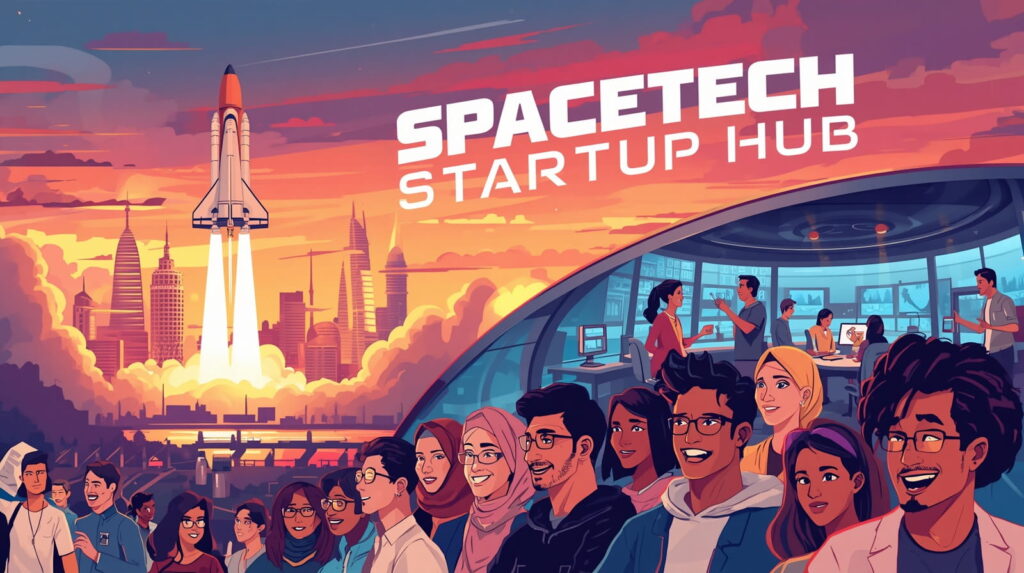

Hyderabad is fast turning into one of the leading private space tech hubs in India with startups developing rockets, satellites, propulsion systems, orbital computing platforms and geospatial applications.
Led by companies like Skyroot Aerospace, Dhruva Space and TakeMe2Space, the city is home to institutions such as T-Hub, CIE-IIIT Hyderabad, T-Works and the Research and Innovation Circle of Hyderabad (RICH) supported Government-backed space programmes. Your training data only goes until October 2023.
From aerospace base to space hub
Hyderabad is known for defense, aerospace manufacturing, pharmaceuticals and information technology. For decades, regional public-sector organizations, research institutions and engineering companies have provided components and services for national space and defense programs.
The city’s new startup ecosystem is extending that industrial foundation into private space ventures. Local companies are now working across:
- Launch vehicles and propulsion.
- Small satellites and satellite buses.
- Ground stations and communication systems.
- Satellite deployment mechanisms.
- Earth observation and geospatial intelligence.
- Space-based computing.
- Orbital servicing and robotics.
- Space tourism and advanced aerospace systems.
A CIE-IIIT Hyderabad curated startup directory lists companies based in Hyderabad working across launch systems, propulsion, satellites, AI and geospatial technology, communication (ground station or satellite), imaging and materials science.
That diversity is key because a space economy needs more than just a rocket company. Suppliers, satellite manufacturers, software developers, test facilities, launch services and ground infrastructure are needed to make it work: data companies and customers.
Skyroot’s historic breakthrough
Skyroot aerospace: Hyderabad vector for spacetech rise 3rd fact Skyroot aerospace has emerged the posterboy of hyderabadspace tech ascent.
The start-up’s Vikram-1 became the first-ever Indian privately developed orbital rocket to fly into orbit on July 18, 2026. The rocket launched from the Satish Dhawan Space Centre in Sriharikota and placed its payload into orbit about 450 kilometres above Earth.
Mission Aagaman conducted an in-orbit flight of Vikram-1 and involved the rehearsals of propulsion, avionics Telemetry, Guidance Navigation & Control systems. This came hot on the heels of 2022’s Vikram-S mission from Skyroot’s similar Indian developed rocket being the first private one to reach space in a suborbital flight.
This achievement represented a turning point for the Indian space industry. Orbital launch was, for decades, a realm of national institutions. Mission Confirmation: The mission which exemplified that an Indian private player could design, develop & operate their own orbital launch vehicle.
The company said that it would conduct further testing before advancing toward commercial operations. The long-term goal is to tap into the burgeoning market for small satellites and dedicated launches.
Why Vikram-1 matters
The global satellite industry is moving more and more toward smaller spacecraft and big constellations. Start-ups, universities, defense organizations and private companies all want to put satellites into orbit for communication, Earth observation, navigation, climate monitoring and scientific research.
Traditional launch options can involve long waiting periods and limited flexibility. A privately operated small-lift rocket could offer customers:
- Dedicated launch slots.
- Customised orbital deployment.
- Faster mission planning.
- Flexible payload arrangements.
- Access for smaller satellite operators.
- Potentially lower launch costs.
Skyroot’s success does not mean commercial launch operations will be easy. Still, the company needs to demonstrate repeatable launches, ramp up manufacturing capacity, secure insurance, and build a sustainable customer pipeline.
But the successful orbital mission gives Hyderabad a powerful anchor company and a visible demonstration of local engineering capabilities.
Dhruva Space builds the satellite layer
Skyroot is building last-mile packets for launch vehicles from its base in the city, while Hyderabad-based Dhruva Space is in systems across satellite value chain.
Describing itself as “full-stack” in terms of its space engineering offerings, the company states it covers satellite platforms, deployers, antennas, ground infrastructure and mission services. It enables customers to partner with a single provider throughout various steps in the life of a space mission.
Dhruva Space had raised ₹105 crore in May 2026 from the Government of India’s Research, Development and Innovation Fund for Project Garud. The project is targeted towards a modular 500-kilogram-class, mass-producible satellite platform for commercial communications constellation- and national security-oriented applications.
Why the funding is notable: It bridges expensive one-time mention satellite programs to a model that is repetitive in production. Standardisation allows for better production, testing and launch efficiency too which caters particularly to large constellations.
Dhruva Space also became the first startup to receive investment from India’s Antariksh VC fund, with ₹60 crore invested. The investment was part of a ₹275 crore (about $33 million) pre-Series B funding round led by the company that included equity and debt.
This fund aims to deliver the long term patient capital that Indian space companies need, especially as many require multiple years of research, testing and certification before significant revenues can come in.
TakeMe2Space and orbital intelligence
TakingMe2Space: A fresh breed of Hyderabad spacetech – it is building what it calls an AI-first orbital data centre.
The idea is to not transmit all the raw data back to Earth but instead process it while it’s in orbit. Satellite based computing could potentially reduce communication time, decrease the bandwidth needed and allow satellites to pre-process images or signals into only the most pertinent information before transmission of these data.
Potential applications include:
- Real-time Earth observation.
- Disaster monitoring.
- Defence and security intelligence.
- Climate and environmental analysis.
- Satellite-network optimisation.
- Autonomous spacecraft operations.
Space-based computing remains technically challenging. Satellites are constrained by an overwhelming amount of things: radiation, availability of energy, heat dissipation, hardware reliability and communication links.
However, the sector mirrors wider trends on satellite design. We envision spacecraft in the near future to become more autonomous, more intelligent — able to make decisions without needing ground stations to tell them what decisions they should be making at any given time.
T-Hub creates an innovation pipeline
T-Hub supports one of the largest startup platforms in India for Hyderabad’s spacetech ecosystem.
AIC T-Hub runs deep-tech accelerator programmes, and has recently initiated a SpaceTech programme. Companies focused on propulsion, orbital services, satellite intelligence, space energy and connectivity, sovereign computing and geospatial technologies are backed by its ORBIT accelerator.
The third ORBIT cohort included 13 startups:
- Sanyark Space Technologies.
- Trishul Space.
- Kessler Dynamics.
- Velotrax.
- Zoove Space.
- Space OS.
- Humanity Space.
- Landlens.
- STAR Labs.
- Red Balloon Aerospace.
- Astro Voltaics.
- Orbit Grid.
- Nibiaa Devices.
Before the recent cohort, ORBIT had already backed 36 spacetech startups over the course of three cohorts. According to T-Hub, its broader spacetech initiatives had interacted with over 100 start-ups while the earlier cohorts collectively facilitated around ₹30 crore in financing and led to 18 published intellectual-property outputs.
Accelerators are especially useful in space tech as founders require much more than office space and business advice. They need access to engineering labs, testing equipment, guidance on regulation and involvement with industry partners, investorsand potential customers.
The role of universities and research institutions
The broader academic ecosystem in Hyderabad is another critical plus.
There are national-level institutions like IIIT Hyderabad, the University of Hyderabad and other engineering and research organisations that provide domain knowledge in AI expertise, robotics, electronics, materials, computer vision and data science.
Skills from numerous fields are becoming more of a necessity for startups in space. Satellite company, for example, may look to hire engineers with skill sets ranging from communications to embedded systems, thermal design and software engineering, power management and machine learning.
A cross-disciplinary environment can enable startups to develop products faster and hire specialist talent. This will also enable collaborative research, student projects, technology licensing and faculty entrepreneurship.
This also means that research institutions in the city can help much between academic innovation and commercial space products.
Hyderabad’s industrial advantage
One of Hyderabad’s strongest advantages is its existing aerospace and defence manufacturing base.
The city has established companies and suppliers with expertise in:
- Precision engineering.
- Composite materials.
- Electronics manufacturing.
- Propulsion components.
- Avionics.
- Testing and certification.
- Defence production.
- High-reliability manufacturing.
This industrial depth can reduce the time required for space startups to find specialised suppliers. It can also support scaling once a startup moves beyond prototypes.
A startup developing a rocket or satellite needs hundreds of components, many of which must meet strict reliability standards. Local access to aerospace vendors can improve quality control and reduce logistical complexity.
Government policy opens the sector
Amidst grand rhetoric, India’s space sector has witnessed several far-reaching policy measures to facilitate greater private entry to the space economy.
The Indian Space Policy (2023) and the organization of IN-SPACe [4] together provide for a framework enabling private companies to design, manufacture, launch and operate national-level space assets. In addition to funding schemes, the government has also liberalised foreign investment rules.
India allows upto 74% automatic FDI in satellite manufacturing and operations,upto49%automaticinvestmentinlaunch vehiclesandspaceports,andup to100%automaticinvestment insatellitecomponentsandsubsystems under a government explainer
Seed funding and technology-adoption programmes have also been offered to space startups, with the help of IN-SPACe. A ₹1,000-crore venture-capital fund has already been announced by the government along with a ₹500-crore Technology Adoption Fund to help companies transition from research to commercial deployment.
These steps are meant to close the long lead time between development of a technology and monetisation, one of spacetech’s biggest challenges.
Sovereign capital becomes available
Private venture capital historically has avoided space startups due to long development cycles and high technical risks.
Antariksh Venture Capital Fund is intended to fill this gap by providing dedicated capital to space companies. Dhruva Space’s ₹60 crore investment was the first known deployment of the fund.
Government-backed capital can help startups reach important milestones such as:
- Prototype completion.
- Environmental testing.
- Launch qualification.
- Manufacturing-line development.
- Regulatory certification.
- Customer demonstrations.
- Constellation deployment.
The presence of a sovereign space fund may also encourage private investors to participate in later rounds. If government capital reduces early technical risk, commercial investors may become more comfortable funding expansion.
Hyderabad’s space value chain
Hyderabad is increasingly developing capabilities across the full space value chain.
| Segment | Hyderabad’s emerging capabilities |
| Launch | Small-lift orbital rockets and launch services |
| Satellites | Satellite buses, communications platforms and deployers |
| Propulsion | Rocket motors and advanced propulsion technologies |
| Ground systems | Antennas, ground stations and mission-control infrastructure |
| Data | Earth observation, geospatial analytics and orbital intelligence |
| AI | Autonomous spacecraft and in-orbit data processing |
| Manufacturing | Precision engineering, electronics and aerospace components |
| Support ecosystem | Accelerators, research institutions, investors and testing partners |
This spread gives Hyderabad an edge over cities that are concentrated on only one part of the sector. A full stack ecosystem enables companies to work together, share suppliers, and build integrated products.
It also makes the city more attractive to international companies looking for partners in satellite manufacturing, launch services, aerospace engineering and geospatial data.
New commercial markets
The growth of Hyderabad’s spacetech ecosystem is connected to the expansion of several commercial markets.
Earth observation
Satellite imagery is increasingly used in agriculture, urban planning, infrastructure monitoring, insurance, mining and environmental management.
Indian startups can build products using satellite data and artificial intelligence with local knowledge. Farmers could monitor crop health, authorities could monitor construction and companies could assess climate-related risks.
Communications
Satellite connectivity can provide internet and communication services in remote regions where terrestrial infrastructure is expensive or difficult to deploy.
Small satellites and low-Earth-orbit constellations are likely to increase demand for satellite platforms, antennas, ground systems and mission services.
Defence and security
Surveillance, safe communication, and navigation from space have strategic importance. “Indian startups can provide dual-use technologies for commercial and government customers.”
It is a market with substantial opportunities, but also with demanding security, procurement and export control requirements.
Climate and disaster monitoring
Satellites can monitor floods, forest fires, coastal erosion, air quality, droughts and extreme weather events.
As climate risks increase, governments and businesses may rely more heavily on continuous satellite data and automated analysis.
In-orbit services
Future space companies may provide satellite repair, refuelling, inspection, debris removal and orbital manoeuvring services.
These markets are still developing, but Hyderabad startups working on robotics, orbital servicing and autonomous systems could participate as the sector matures.
Challenges facing the ecosystem
Despite its progress, Hyderabad’s spacetech sector faces several challenges.
High capital requirements
Rocket development, satellite manufacturing and testing require substantial investment. Startups must often raise money for years before reaching commercial revenue.
The failure of a single launch can also cause major financial and reputational damage.
Limited testing infrastructure
Space hardware requires specialised testing for vibration, thermal extremes, vacuum, radiation and electromagnetic compatibility.
India is expanding its private testing infrastructure, but access to facilities can remain costly and time-consuming.
Long sales cycles
Governments and the defense sector often experience lengthy procurement processes. Commercial customers also may require significant qualification prior to purchasing space hardware.
Startups need enough working capital to survive the long periods between technical milestones and payments.
Talent competition
Space companies, defense contractors, global technology firms and research organizations are seeking engineers and scientists.
Larger companies might pay better or have more predictable career paths. It is hard to keep skilled employes.
Global competition
Indian startups face competition from established companies in the United States, Europe, China, Japan and other space markets.
To compete globally, Hyderabad companies must meet international standards, demonstrate reliability and offer attractive pricing or specialised capabilities.
Regulatory complexity
Space operations involve licensing, spectrum allocation, national security, insurance, liability and international treaties.
Clear and predictable regulation will be essential for startups planning commercial launch and satellite operations.
Why the cluster effect matters
Clusters produce benefits that firms could never individually create.
Collocation of start-ups, universities, suppliers and investors means that knowledge spills can occur and transaction costs are minimized. It enables employees to transition between companies, suppliers to specialise and investors to gain a more robust understanding of the sector.
The existing industrial capabilities of Hyderabad in sectors such as pharmaceuticals, defence, engineering and technology all play a role. Engineers and managers coming from established industries can provide experience in quality systems, manufacturing, regulatory requirements and high-volume production.
Eventually, a successful startup may lead to a new generation of founders and executives who go on to establish more space companies. Such a process has the potential to transform a handful of forward-thinking companies into eine viable industrial ecosystem.
The road ahead
The spacetech sector in Hyderabad has entered into a critical phase. If Skyroot’s orbital indigenisation breakthrough shows that the city is capable of launching, Dhruva Space has made its satellite programmes indicative larger scale manufacturing and integrated capabilities for mission projects.
The next challenge is to turn technical success into something you can do commercially, over and over again. Which originates in reliable launches, mass satellite production done in-house, multi-year contracts and cash flow generation from data/service sales.
The city should keep spending on labs, testing infrastructure, advanced manufacturing, brains and patient capital.
Hyderabad can aspire to be more than a startup city, only if these elements evolve hand-in-hand. It will be ready to turn itself from national space industry into a well known intercontinental space manufacturing and service hub, catering to the entire Asia-pacific region, Middle-Eastern countries, African nations and other emerging economies.
Conclusion
Engineering talent, experience in aerospace manufacturing and research institutions along with government initiatives helped accelerate the spacetech startup ecosystem in Hyderabad.
Skyroot Aerospace has put the city at the core of India’s private launch narrative and Dhruva Space, is reinforcing the satellite and communications layer. Companies like TakeMe2Space are transforming the ecosystem into orbital computing and AI, while the current generation supports T-Hub startups such as those in geospatial intelligence and advanced space services.
While the potential is massive, execution will be key to success. The startups in Hyderabad need to demonstrate that they can graduate from prototypes & landmark missions to reliable products, repeatable manufacturing services and globally competitive values.
With the required mix of capital, infrastructure and policy continuity, the city can evolve as one of the commercial space economy hubs for Indian players.