

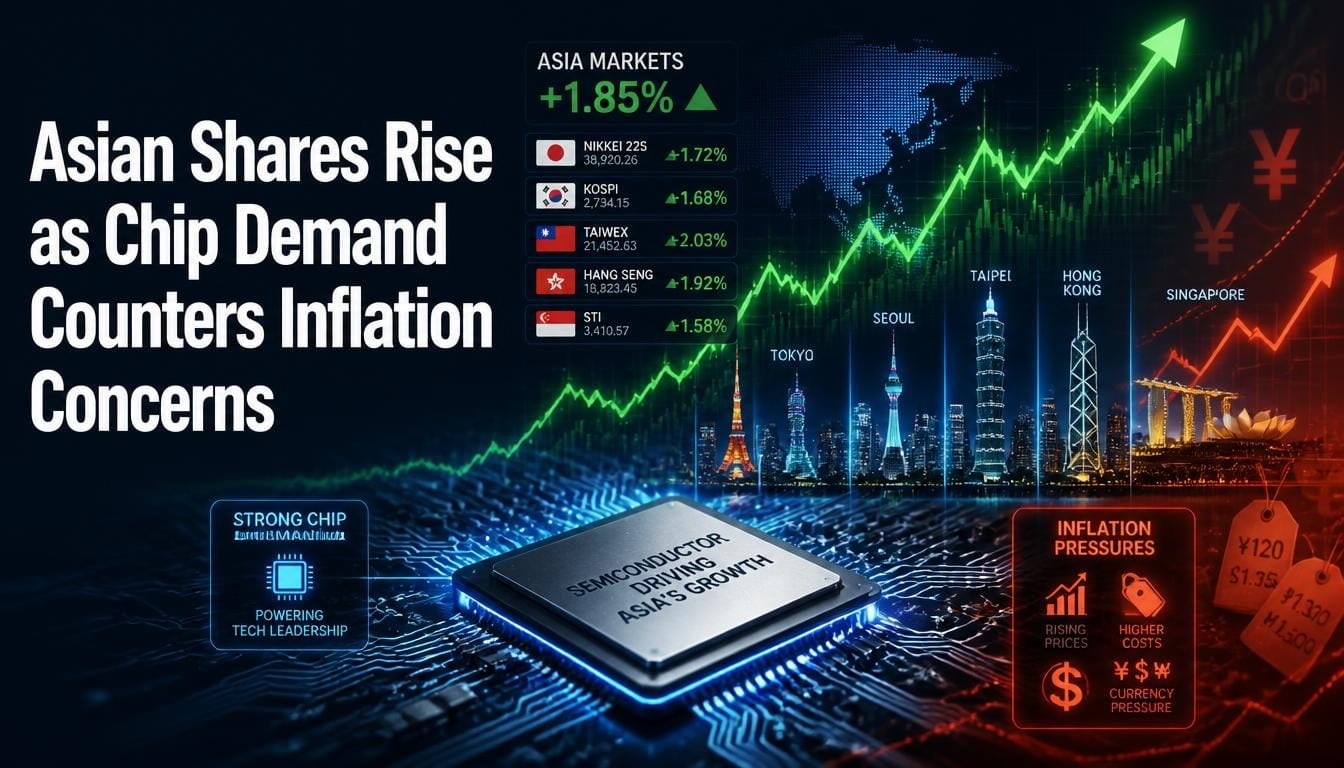

Most of the stock markets in Asia were higher on Wednesday, November 11th because of an increased demand for AI related chips, which helped lift stocks in Japan and South Korea. This came after the U.S. stock market declined due to inflation concerns, illustrating the two opposing factors investors have to consider: a potential increase in technology earnings versus a possible increase in interest rates.
The Nikkei 225 index of Japan increased by 0.8% to close at 60,942.48, and the Kospi index of South Korea gained 1.6% to finish at 5,321.10, based upon Associated Press Market Coverage. In addition, Samsung Electronics rose 2.3%, and SK Hynix rose 3.4%. On the other hand, both the Hang Seng index of Hong Kong decreased by 0.7%, and the Composite index of Shanghai decreased by 0.3%, indicating that there was no consistent regional rally during the day.
Chip optimism supports selected markets
The stock market gains in Seoul and Tokyo indicate that investors remain interested in stocks of businesses involved in chip manufacturing and AI infrastructure. Chips with advanced features are essential for operating data centers and computer systems utilized for training and executing AI models. Businesses that produce chips and/or memory devices have experienced benefits due to the expected high demand, however, their stock price may fluctuate dramatically based on changing projections.
The high level of interest in the markets does not mean each and every investment made into artificial intelligence (AI) will provide the expected returns. Investors are attempting to determine how much companies will invest in data centers, how quickly that capacity will be utilized, and if the revenue from that utilization justifies the investment. Strong demand for chips may help support chip makers; however, the overall technology sector continues to be susceptible to fluctuations in valuation and shifts in interest rate expectations.
A counterweight occurred in Japan as well: SoftBank Group dropped 3.7 percent as the investor posted a first-quarter net loss of 1.1 trillion yen ($7 billion), according to the Associated Press. The loss reflects the contrast between public interest in the AI industry and the financial success of individual companies. While headlines regarding AI demand may be positive, they do not alleviate company-specific losses or investment risk.
Inflation keeps bond yields in focus
On Tuesday, the S&P 500 closed down by 0.4 percent, the Dow Jones Industrial Average fell by 0.3 percent, and the Nasdaq composite dropped by 0.7 percent on Wall Street as reported by AP. Treasury yields were pushed up due to a higher than expected U.S. inflation rate for October. According to AP, the 10-year yield increased from 4.88 percent late Monday to 4.99 percent.
Higher yield levels are significant because they increase the cost of borrowing throughout the economy and potentially reduce the value of future corporate earnings in current-day terms. Yields can also influence whether investors find safe-haven bonds more appealing than stocks. What the Federal Reserve decides next will depend on the incoming data it receives and its evaluation of inflation and economic conditions. One report alone will not dictate what action the Fed takes. According to AP, after receiving the inflation reports, traders began placing bigger bets on a possible larger interest-rate hike in December.
Markets are pricing different stories at once
The separation of markets illustrates how investors can react to different signals simultaneously. For example, chip makers can see gains based on expectations of high levels of order activity, despite rising bond yields. Conversely, export-oriented companies may profit from exchange rate fluctuations, whereas those that rely heavily on borrowed funds can find themselves under pressure due to increased interest rates. Furthermore, regional indexes reflect the earnings potential, policies and positions taken by investors in each region, rather than a single global trend.
On Wednesday, China started its annual Singles’ Day shopping celebration which will be used to measure how much consumers are spending. The event has gained a great deal of interest from investors as it offers insights into household sentiment and the health of e-commerce. Trading on both Hong Kong and Shanghai exchanges was volatile when they opened on Wednesday morning, however, what matters is the final results of the shopping celebration rather than the early trading.
Australia’s S&P/ASX 200 gained 0.1%, according to AP, which was a further example of how different regions perform relative to each other. Long-term investors are interested in the long-term patterns in earnings, inflation, credit conditions, and consumer spending, not so much in daily price movements. Daily fluctuations in stock prices usually represent revisions of investor expectations rather than an assessment of the overall health of the economy.
What investors will watch next
In the short term, investors will be watching to see if U.S. inflation remains higher than anticipated and if this causes the Federal Reserve to adjust its policy. Additionally, investors will want to see what companies are saying about their future semiconductor orders and if there is any indication that AI-related spending is leading to increased revenues. Also, investors in China may get some additional insight into household consumption from the results of shopping festivals; however, no single festival can provide a complete picture of the country’s economic activity.
The dilemma for Asian markets is whether tech companies will generate sufficient profits to counter the negative impacts of rising interest rate-related financing expenses, or if interest rate hikes will reduce stock valuations despite growing consumer demand. Neither outcome can be guaranteed. Prices in financial markets are influenced by the markets’ perception of future events, which means that these expectations are subject to change as additional information becomes available.
Wednesday’s trading day reflected the market’s uncertainty. Asia experienced strong demand for semiconductor chips which provided support for some markets. However, high inflation in the U.S. resulted in increased yields and negative pressure on U.S. equity prices. Investors are not viewing AI and inflation as two separate issues; instead, they are looking at how each impacts corporate profitability and the prices investors are prepared to pay for stocks. Future economic reports and earnings announcements will determine if the positive sentiment toward chips will continue to offset rising interest rates.