


AMD has reported its strongest quarterly revenue to date, posting $13.4 billion in revenue for the third quarter of 2026 as demand for artificial intelligence infrastructure continued to support its data-centre business. The semiconductor company said revenue increased 45% compared with the same quarter last year, while sales in its Data Center segment rose 97% year over year to a record $8.5 billion.
The results, announced on November 3, underline the growing importance of data-centre processors and accelerators in the global semiconductor market. Companies developing and operating large AI systems require substantial computing capacity, creating demand for both graphics processing units (GPUs) and server central processing units (CPUs).
AMD’s latest figures show that its data-centre business has become a major contributor to overall company performance. However, the results also reveal differences across its business segments, with gaming revenue declining even as demand for server and AI-related products strengthened.
Revenue and profit increase across the quarter
For the three months ended September 26, 2026, AMD recorded revenue of $13.377 billion, compared with $9.246 billion in the same period a year earlier. That represents a 45% year-over-year increase and a 16% rise from the second quarter of 2026.
The company’s GAAP net income reached $2.428 billion, up from $1.243 billion in the third quarter of 2025. Diluted earnings per share increased to $1.46, compared with $0.75 a year earlier.
AMD also reported non-GAAP net income of $3.471 billion and non-GAAP diluted earnings per share of $2.09. These adjusted figures exclude certain items and should be considered separately from the company’s GAAP results.
Operating income under GAAP reached $2.832 billion, compared with $1.270 billion in the year-earlier quarter. The company’s GAAP gross margin was 54%, two percentage points higher than the 52% reported for the third quarter of 2025.
The figures indicate that AMD’s growth was accompanied by an improvement in profitability. The company attributed the performance to stronger demand across its data-centre portfolio and higher sales of its computing products.
Data-centre business becomes a central growth driver
The most significant part of AMD’s latest results was its Data Center segment, which generated $8.5 billion in revenue, an increase of 97% compared with the third quarter of 2025.
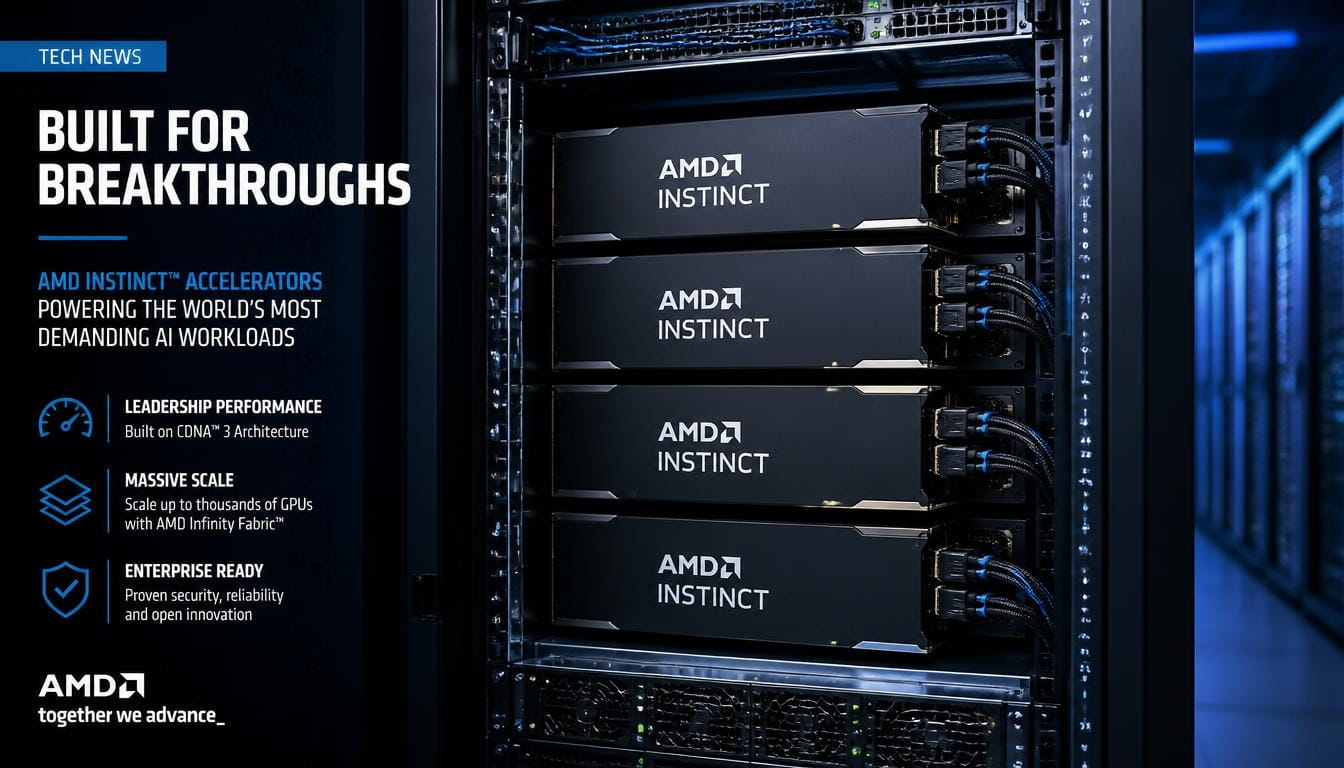
AMD said the performance was driven by demand for its EPYC server processors and the launch of its Instinct MI450 Series GPUs.
These product categories serve different but complementary roles in modern computing infrastructure. Server CPUs handle general-purpose processing and coordinate workloads, while AI accelerators are designed to perform the large-scale mathematical operations required for training and running many artificial intelligence models.
As companies expand AI infrastructure, demand is increasing for complete systems rather than individual chips alone. These systems combine processors, accelerators, networking, memory, storage and software. AMD’s strategy has increasingly focused on supplying several of these components and supporting them through its software ecosystem.
The company also highlighted the use of its Helios rack-scale systems by major technology companies. AMD stated that Anthropic, Meta, Microsoft, OpenAI and Oracle Cloud Infrastructure were running models and workloads on its first Helios rack-scale solutions, powered by Instinct MI450 Series GPUs and sixth-generation EPYC CPUs.
The announcement is relevant because it indicates that AMD is seeking a larger role in the infrastructure used by major AI developers and cloud providers. However, the company did not disclose individual customer revenue contributions in the results release.
Gaming and embedded segments show different trends
AMD’s results were not uniformly positive across all business areas.
The combined Client and Gaming segment generated $3.7 billion in revenue, down 8% year over year. Within that segment, client revenue reached approximately $2.9 billion, increasing 7%, supported by sales of Ryzen mobile processors.
Gaming revenue was $773 million, a 40% decline from the same quarter last year. AMD attributed the decrease to lower semi-custom and graphics revenue.
The Embedded segment delivered a stronger performance. Revenue reached approximately $1.1 billion, up 29% year over year, with growth across aerospace and defence, automotive, communications and industrial markets.
The segment results demonstrate how different parts of the semiconductor market are moving at different speeds. AI infrastructure is generating significant demand for data-centre products, while gaming-related sales are facing a different market environment.
AMD raises expectations for the fourth quarter
AMD’s outlook points to further growth in the final quarter of 2026. The company expects fourth-quarter revenue of approximately $17 billion, plus or minus 3%.
At the midpoint of that forecast, the figure would represent approximately 66% year-over-year growth and a sequential increase of around 27%. AMD expects a non-GAAP gross margin of approximately 55%.
These figures are management’s expectations, not completed results. Actual performance could differ depending on customer demand, supply conditions, competition, product availability and broader market conditions.
The forecast also places attention on AMD’s ability to scale production of its upcoming Helios and Venice platforms. The company said demand across its Data Center portfolio remains strong.
What the results mean for the AI chip market
AMD’s quarterly performance adds to evidence that investment in AI computing infrastructure is translating into substantial semiconductor revenue. The market includes established chip suppliers, cloud companies developing their own processors, and new businesses attempting to build specialised AI hardware.
For customers, competition among suppliers can create more options for building large computing systems. It can also encourage improvements in performance, power efficiency, software support and system-level integration.
For AMD, the challenge is not simply to report strong demand in one quarter. It must maintain product availability, deliver competitive performance, support software developers and convert large infrastructure projects into sustained revenue.
The company’s growing data-centre business is an important part of that effort, but its other segments remain relevant to its overall financial performance. The decline in gaming revenue shows why it would be premature to treat the AI market as a guarantee of growth across every part of the semiconductor industry.
AMD’s third-quarter results provide a clear snapshot of the current shift in technology spending: data-centre and AI infrastructure are becoming increasingly important to the business of chipmaking. The next test will be whether the company can meet its fourth-quarter forecast and sustain growth as competition in AI hardware intensifies.